



Personal Branding
Why Authenticity Alone Is Not Enough in Personal Branding
Why Unstructured Authenticity Fails
Authenticity is powerful, but unstructured authenticity, authenticity without filter, focus, or strategic intent, can undermine your personal brand. The mantra "just be yourself" sounds liberating, but taken to an extreme, it results in a brand that is confusing at best and off-putting at worst.
Here is why authenticity alone, in a vacuum, often fails:
1. Mixed Messages and Brand Confusion
Without a clear framework, sharing whatever feels authentic in the moment sends mixed signals. One day you are ranting about a pet peeve, the next you are pitching a product, and the day after you are posting cat photos. While all of these may be "truly you," they appear inconsistent to an outsider.
If people cannot quickly tell what you are about, they will not remember or care. A personal brand with no unifying message leaves the audience asking, "What do you stand for?" Authenticity without focus simply becomes noise.
2. Oversharing and Professional Boundaries
Authenticity without discipline can easily morph into "TMI" (Too Much Information). When you share personal drama on a platform meant for industry insights, you risk undermining your professionalism.
Personal stories should have a point that ties back to your overall message or expertise. Without relevance or a lesson, you might gain attention, but you also water down your authority. This often crosses into performative vulnerability, sharing for shock value or sympathy rather than insight. Audiences can sense this dissonance, and it erodes trust.
3. Lack of Consistency Erodes Trust
An effective brand requires a level of consistency. If you post purely based on your mood, your followers won't know what to expect. Imagine a thought leader who is upbeat one week, doom-and-gloom the next, and pivoting to silly memes the week after.
Consistency does not mean being fake; it means reinforcing your key values and themes repeatedly so they stick. If you are too unpredictable, you risk appearing inauthentic because people start to question which version of you is the "real" one.
4. Authenticity is Not a License for Bad Behavior
Authenticity is often misinterpreted as "saying whatever you want" without a filter. However, being true to yourself is not an excuse for a lack of tact or empathy. If your "authentic" expression lacks regard for your audience’s feelings, you will undermine the relationships you are trying to build.
Raw honesty without consideration of impact can come across as narcissistic. As experts warn, authenticity without empathy is dangerous. In personal branding, how you enact your values and their impact on others matters just as much as the values themselves.
The Bottom Line: Unstructured authenticity fails because it lacks the clarity and intention that give a brand its strength. Authenticity is the starting point, not the destination. You need a guiding strategy to harness your real self in a way that resonates with others.
Emotional Expression vs. Intentional Positioning
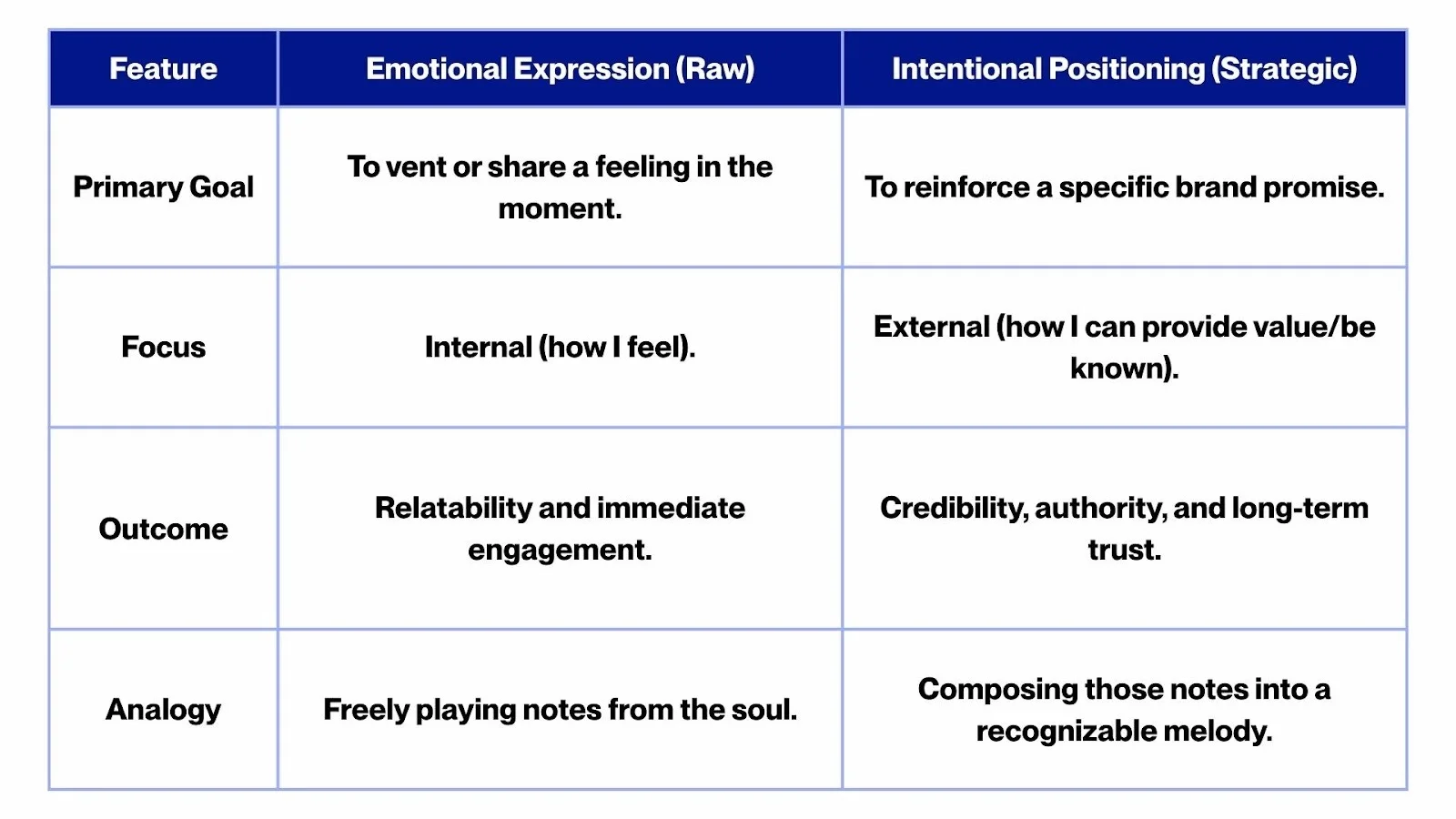
There is a stark contrast between simply expressing yourself emotionally and crafting a position for your brand in people’s minds. Both involve revealing who you are, but the approach and outcome differ dramatically.
Emotional Expression: Authenticity in the Raw
This is the "heart-on-sleeve" approach. You feel something strongly and you express it—joy, frustration, excitement, or vulnerability. Emotional expression is vital because it shows your human side and makes you relatable.
- The Benefit: Personal anecdotes boost engagement. People crave human connection and want to know the person behind the title. A founder sharing the anxiety of a failed pitch often strikes a deeper chord than a standard business tip.
- The Risk: If unbridled, emotions can overshadow your expertise. If 90% of your content consists of "sentimental diary entries" and only 10% highlights your skills, your brand may be seen as personal but not professional.
- The Balance: Aim for a ratio, such as 70% professional insights and 30% personal content. Sharing a struggle is most impactful when you tie it to a lesson learned or how it relates to your field.
Intentional Positioning: Strategic Authenticity
Intentional positioning is about defining how you want to be perceived and aligning your communications to reinforce that image. It is not about faking a persona; it is about choosing which facets of your authentic self to spotlight.
- The Process: It starts with clarity regarding your core values, mission, and unique value proposition. You decide on a "lane", for example, "the candid CFO who speaks about finance with humor."
- The Filter: Before posting, ask: "Is this conveying the message I intend for my brand?" If you are a fitness coach focused on resilience, a "bad day" post shouldn't just be a rant; it should demonstrate how you used your own techniques to overcome that bad day.
- The Outcome: You express the aspects of your personality that reinforce your professional story. This ensures your brand is both genuine and differentiated.
Comparison: Raw vs. Strategic Authenticity
The Sweet Spot
When you achieve this balance, you hit the "sweet spot": you appear real and relatable, yet also credible and focused. People feel your humanity while clearly understanding your expertise. It isn't authenticity versus strategy, it is authenticity plus strategy.
Misaligned Authentic Brands: When Keeping It Real Goes Wrong
Being authentic without alignment can lead to high-profile misfires. These examples show that broadcasting one’s unfiltered self can backfire if it is out of step with audience expectations or professional context.
1. The "Crying CEO" – Authentic Emotion, Wrong Execution
In 2022, CEO Braden Wallake went viral for the wrong reasons. After laying off several employees, he posted a selfie of himself in tears on LinkedIn, accompanied by a heartfelt caption about how difficult the decision was for him.
- The Intention: To show vulnerability and prove that CEOs are human.
- The Result: A social media firestorm. Instead of praise, he was met with mockery and labeled the "Crying CEO."
- The Misstep: While his feelings may have been genuine, his execution was tone-deaf. By making the layoffs about his emotions rather than the employees who lost their livelihoods, the post felt like "performative empathy."
- The Lesson: Share vulnerability only when it is context-appropriate. LinkedIn is a professional platform; a leader’s focus during a crisis should be on providing value or showing respect to others, not seeking sympathy for themselves.
2. Elon Musk – Unfiltered Persona vs. Company Image
Elon Musk is a master of personal branding, but his case illustrates how authenticity can become a liability when it clashes with corporate strategy. Musk’s Twitter (now X) presence is legendary for its unvarnished opinions, memes, and political feuds.
- The Conflict: Musk leads companies like Tesla, which has a brand ethos rooted in clean energy and a largely progressive customer base. Musk’s personal "authentic" outbursts, often polarizing and controversial, frequently contradict the values his companies project.
- The Result: Alienation. Reports show that some loyal Tesla customers have reconsidered their support for the brand because they no longer want to be "tarnished by association" with Musk’s personal brand.
- The Misstep: Musk often blurs the line between his personal identity and his corporate mission. When his behavior becomes erratic, it creates a "trust gap" and tarnishes the business image.
- The Lesson: If you are the face of a business, your authentic actions cannot be divorced from your company’s brand. You may need to dial certain parts of your personality up or down to stay aligned with your broader purpose.
Key Takeaways from Misalignment
- Context and Tone Matter: Authentic content can still be unprofessional or "cringe" if it ignores the platform or the moment.
- Guardrails of Relevance: Not every authentic impulse is worth broadcasting. If an opinion contradicts the narrative built around your mission, it may be better left private.
- Audience Awareness: Authenticity is only effective if it considers the impact on the receiver.
3. When Authenticity Turns into "Authentic™"
Another form of misalignment occurs when "being real" becomes a forced strategy, a faux-authenticity. This happens when individuals or companies adopt a casual, meme-filled, or "real talk" tone that doesn't match their actual identity or actions.
- The Trap: Copying vulnerability trends purely for engagement rather than out of a genuine desire to share. This is often called "performative authenticity."
- The Result: The internet has a sharp radar for calculated moments. When a post is sniffed out as a bid for likes rather than a sincere reflection, the backlash is harsh, often branding the person as a phony.
- The Lesson: Authentic content must be both sincere and aligned with who you actually are. If you force a persona or mimic others, you end up with the worst of both worlds, neither strategic nor sincere.
The Intersection of Truth and Relevance
These examples highlight a crucial truth: Authenticity must be coupled with clarity and alignment to be effective. A strong personal brand thrives at the intersection of what is true to you and what is relevant to your audience.
If you focus only on "truth to self" without considering relevance and strategy, you risk obscurity or reputational damage. As branding consultant Rex Whisman notes, a brand must integrate strategic purpose, clarity of mission and impact, to truly resonate.
Key Insight: Authenticity is the fuel, but strategy is the steering wheel. Without both, you are either going nowhere or headed for a crash.
Clarity Amplifies Authenticity
If authenticity is the foundation of your personal brand, clarity is the amplifier that makes it shine. Clarity means having a well-defined understanding of your brand’s core elements: who you are, what you stand for, who you serve, and what makes you different.
When you have this level of definition, every authentic thing you share has a purpose and fits into a bigger picture. Here is why clarity is so powerful:
1. It Tells the Audience What to Remember
In a world of short attention spans, people won't work to figure out your brand, you must spell it out. Brand clarity ensures that when someone visits your profile, they immediately grasp your essence (e.g., "The financial planner for moms in business").
When you share an authentic anecdote within this framework, it has context. For example, if your brand is "bold tech educator," a story about struggling with imposter syndrome reinforces your mission of making tech accessible. Without clarity, that same story is just a random anecdote, interesting today, forgotten tomorrow.
2. It Builds Trust Through Consistency
Clarity allows you to be consistent without feeling "fake." When you understand your values, you naturally filter your expression through that lens. You aren't being inauthentic; you are being selectively authentic in service of a consistent brand.
Over time, this reliability makes people trust the "real you." If your communications zigzag in tone, people become unsure of your character. Clarity provides the guardrails that keep your authenticity from veering off-brand.
3. It Bridges Your Story to Audience Needs
Effective branding is communication, not just self-expression. Clarity forces you to answer: "Why does this matter to the audience?" Sharing a failure is authentic; adding the clarity of "and that is why I help startups avoid that pitfall" makes it valuable. This bridges the gap between personal truth and professional value, transforming a "moment" into a purposeful connection that drives loyalty.
4. It Provides Confidence and Direction
When you are clear on your identity, you gain the confidence to tell your story without second-guessing. A clear, confident voice carries authenticity better than an uncertain one.
Clarity also streamlines your decision-making. You know exactly which opportunities to pursue and which topics to focus on. By hitting consistent notes with your genuine flair, your brand becomes iconic rather than just visible.
How to Achieve Clarity
Getting clear often requires deep introspection and analysis. Many professionals use exercises like crafting a Brand Positioning Statement:
"I am [X] who does [Y] for [Z], because [My Why]."
Filling in these blanks creates a guiding star. Agencies like Ohh My Brand help individuals find this "sweet spot" between an authentic story and market needs.
Conclusion: The Focused Lens
Clarity doesn’t restrict your authenticity; it focuses on it. It is like passing light through a lens: instead of a scattered, diluted glow, you get a high-impact beam. As the saying goes, "If you confuse, you lose." Clarity ensures you don't confuse, allowing your authenticity to land, resonate, and build lasting trust.
Aligning Authenticity with Strategy: How to Build Your Brand with Intention
Neither authenticity nor strategy can stand alone; the magic lies in marrying the two. This is known as strategic brand alignment: aligning who you are with what you want to achieve, in a way that resonates with those you want to reach.
Here are the practical steps to align your authentic self with a strategic personal brand:
1. Start with Self-Discovery and Define Your Core
Authentic alignment begins with introspection. Before looking at market trends, you must define your own "authentic fuel."
- Core Values: What principles will you not compromise on?
- Mission and Passion: What personal experiences shape your perspective? You might find a recurring theme, such as "empowerment through education" or "disruptive innovation."
- Strengths and Skills: What is your unique combination? Perhaps you are a data scientist who is also a gifted public speaker.
- Personality and Style: Are you analytical or whimsical? High-energy or calm?
Without this foundation, any branding effort will lack sincerity. By defining your core first, you ensure your strategy is built on reality, not a fabricated image.
2. Craft a Clear Positioning Statement
Once you have self-knowledge, articulate it into a concise positioning statement. This is your brand’s "North Star."
The Formula: > "I am a [Role] helping [Target Audience] to [Outcome] by [Unique Approach], because [Your 'Why']."
Example: "I am a marketing strategist who helps non-profits grow through digital storytelling by combining data-driven strategy with heartfelt narrative."
This statement guides your content, filters your opportunities, and helps others refer you for the right reasons. Clarity does not reduce you; it focuses you.
3. Align Your Content with Your Message
Intentionality is key to what you produce. Identify three or four "content pillars" rooted in your authentic interests and plan your output around them.
- The Pillar Strategy: If your pillars are "Tech Innovation," "Leadership Honesty," and "Work-Life Balance," ensure the bulk of your content reinforces these themes.
- The 70/30 Rule: Aim for a balance, perhaps 70% professional insights and 30% personal content.
- The Segue Technique: When sharing personal stories, tie them back to your brand focus. A story about a new puppy can segue into a reflection on "patience in business."
This consistency creates a "resonant echo chamber." It trains your audience to associate specific expertise with your name. When you consistently and authentically speak on a topic, you become the person they think of first.
4. Maintain Professionalism and Context
Being "intentional" means choosing the right setting for different aspects of your authenticity. You might be casual and humorous on X (formerly Twitter), moderately personal yet informative on LinkedIn, and highly polished on your website. All are authentic facets of you, just dialed appropriately for the context.
- Avoid the Overshare Trap: Frame honest or emotional moments within a professional or value-driven context.
- The "Value Rule": Ensure every authentic share inspires, educates, or relates to your community. If a thought is purely for self-centered validation with no takeaway for the audience, it belongs in a personal journal, not on a professional platform.
- The Goal: Strategic authenticity seeks genuine connection. Aligning your feelings with relevant industry conversations keeps your brand both real and respectable.
5. Be Consistent Across Touchpoints
Strategic alignment involves both what you say and how you look. Your authenticity should be cohesive across all visual and verbal interactions.
- Visuals: Use a professional photo that still reflects your personality (e.g., your authentic smile or style).
- Voice: If you are playful in your posts, a stiff, third-person bio will feel jarring.
- Offline Alignment: Your brand should be the same "you" that shows up in meetings or at networking events. Any dissonance, like being warm online but cold in person, erodes trust.
- The Result: Unified vibes across platforms allow your brand to be instantly recognized and trusted, no matter where someone encounters you.
6. Adapt and Evolve Intentionally
Personal branding is not "set it and forget it." As you grow, new facets of your authentic self will emerge. Authenticity isn't static, but evolution must be handled with care.
- Communicate the Pivot: If you shift from being a "finance guru" to focusing on "holistic success," bring your followers on that journey. Explain why your focus is expanding and how it aligns with your core values.
- Avoid the 180: Radical, unexplained turns leave audiences puzzled. Strategic alignment means changes are purposeful and clearly communicated.
- Seek Feedback: Periodically check in with mentors or your audience. Ask: "Is my intended message being understood?" The strongest brands maintain core consistency while adapting to stay relevant.
7. Leverage Expert Guidance and Frameworks
Marrying authenticity with strategy can be complex. You don’t have to do it alone.
- Professional Help: Agencies like Ohh My Brand (OMB) specialize in finding the harmony between being yourself and positioning yourself effectively. They use audits and brand storytelling frameworks to ensure your "clear, intentional positioning" is backed by a solid value proposition.
- Self-Audit: Perform an "authenticity audit" of your digital presence. Review your recent posts to see if they truly reflect your voice or if you’ve drifted into copycat content.
- Frameworks: Use structured flows like Origin Story → Core Message → Audience Pain Points → Solution. This ensures every piece of content connects your personal truth to your audience's needs.
Conclusion: Authenticity + Intention = Personal Branding Success
In the grand scheme of personal branding, authenticity vs. strategy is a false dichotomy. The most successful brands do not choose one over the other, they embrace both. Authenticity provides the soul of your brand, the unique flavor that no one can copy. Strategy provides the structure, the recipe that makes that flavor palatable and desirable to others.
Key Insights Recap:
- Authenticity is a Platform, Not a Building: It is indispensable for trust and differentiation, but without structure, it remains a diffused or even damaging image.
- The Cost of Unstructured Expression: Sharing without a filter leads to mixed messages and undermined credibility. Being true to yourself is not an excuse for abandoning discretion.
- Expression Requires Positioning: Emotional content makes you human, but intentional positioning ensures those stories support the reputation you want to build.
- The Power of Clarity: Knowing your mission and value proposition acts like a beacon, focusing your authentic expression into a signal your audience can clearly receive.
- Strategic Alignment is a Process: Success comes from marrying the authentic "you" with a deliberate plan, defining your niche, planning content pillars, and maintaining consistency.
Moving Forward: The Focused Power
Think of authenticity as raw energy and strategy as direction. Raw energy without direction causes chaos; direction without energy produces no momentum. Combined, they create focused power.
In a world of savvy and skeptical audiences, the brands that thrive will be those that deliver real value from real people. This means being your best, most purposeful self in the spotlight, not a fake persona, but a version of yourself that can genuinely serve and connect with others.
The Final Word: Authenticity needs clarity to connect, and clarity needs authenticity to convince. By providing both, you won't just have a brand that is real, you will have one that is real, resonates, and endures.
Not sure if your current content and messaging are helping or hurting your professional credibility? Ohh My Brand offers private reviews to align authenticity with authority. Contact Ohh My Brand for more details today!



.svg)
.svg)
.svg)
.svg)



.svg)