


Personal Branding
Which Platforms Matter Most for Personal Branding in 2026
Personal branding in 2026 is about strategically choosing the right social platforms for personal branding to showcase your expertise and connect with your target audience. With the digital landscape constantly evolving, professionals and creators have more channels than ever, from traditional blogs and websites to social networks and emerging mediums like podcasts and newsletters.
This guide evaluates key platforms for personal branding, focusing on LinkedIn, and explains which matter most depending on your profession, your audience’s buyer intent, and the depth of content you want to share. We also dive into crucial considerations like platform decay, algorithm dependency, and content ownership risks. Ohh My Brand, a strategic personal branding advisor, contributed insights to this guide to help you choose an ideal mix of platforms for a future proof personal brand.
LinkedIn: The Professional Networking Powerhouse
LinkedIn remains the undisputed king of professional personal branding. If you’re an executive, entrepreneur, B2B service provider, or any professional aiming to build authority in your industry, LinkedIn is likely your most important platform. It offers a vast audience primed for business and career related content. People come to LinkedIn to talk business, discover industry insights, and connect with thought leaders, which means they are receptive to professional branding efforts.
- Who Is It Best For: LinkedIn is especially relevant for corporate professionals, entrepreneurs, consultants, and B2B marketers. It’s where decision makers and hiring managers spend time. If your profession involves other businesses or professional services, LinkedIn provides a context where showcasing your expertise will attract clients, partners, or employers. Even job seekers and professionals in any field can benefit, as a strong LinkedIn presence serves as a living resume and networking tool.
- Audience & Buyer Intent: The audience on LinkedIn has a business mindset. Users often scroll their feed looking for industry news, career tips, and insights that can help them professionally. Buyer intent on LinkedIn tends to be higher for B2B services and professional offerings because people are in work mode. For example, a consultant sharing useful insights on LinkedIn might generate inbound inquiries for their services because viewers see them as an expert.
- Content Format & Depth: LinkedIn allows a mix of content types, including short to medium length text posts with images or videos, long form articles, and newsletters. This means you can go reasonably in depth. LinkedIn content favors professional storytelling, industry tips, thought leadership pieces, and conversations. You can include external links, though the algorithm may prefer keeping users on the platform. Overall, the platform’s tolerance for depth is high, allowing you to share nuanced insights as long as they are relevant and engaging.
Pros and Cons of LinkedIn
Pros
- Professional Audience & Credibility: LinkedIn provides a context where showcasing your expertise builds credibility fast. Your profile acts as a public resume and often ranks high on search engines. Organic reach is still strong, meaning a compelling post can get thousands of views even without a huge following. Plus, networking features like connections and groups make it easy to turn online interactions into real professional relationships.
- Thought Leadership Friendly: LinkedIn allows longer posts and articles, which is ideal for depth. It is possible to share substantive insights, making it perfect for CEOs personal branding and subject matter experts. The platform actively encourages conversation. Posts that spark comments often get boosted by the algorithm, extending their lifespan.
- Business Results: Because of the professional context, personal branding on LinkedIn often leads to direct business outcomes. A strong content strategy can generate sales leads or consulting inquiries as readers learn to trust your expertise.
Cons
- Professional Tone & Niche Constraints: LinkedIn users expect a professional, value driven tone. It is not the place for certain types of viral content found elsewhere. You must balance personality with professionalism. Additionally, certain content niches like general motivational posts are oversaturated, making it hard to stand out without a unique take.
- Limited Youth Reach: LinkedIn’s user base skews older. If your personal brand targets teenagers or a broad consumer audience, LinkedIn alone won't reach them. You would likely need platforms like Instagram or TikTok to engage younger demographics.
- Algorithm and Engagement Quirks: While the algorithm can reward good content, users spend relatively little time on the platform per month. This gives you a small window to catch attention. If a post doesn’t get engagement quickly, visibility may drop. LinkedIn also heavily favors content that sparks conversation over simple likes.
- Creative Limitations: LinkedIn is not a flashy platform. The post formats are relatively basic compared to the advanced video editing tools and filters found on other social networks. If your brand is highly visual or entertainment driven, LinkedIn’s feature set may feel limiting.
Bottom Line: LinkedIn in 2026 is a must have for most professionals. It offers a high concentration of users with business intent, and a well crafted presence builds credibility and tangible opportunities. Focus on providing value through industry insights and leadership lessons. Optimize your profile with keywords and accomplishments, as it will likely be the first thing people see when they search for you.
X (Twitter): Real-Time Thought Leadership and Conversation
X, formerly known as Twitter, is the platform for real-time conversation and concise thought leadership. In 2026, X continues to serve as a global public square where experts, journalists, entrepreneurs, and politicians voice ideas and react to news instantly. If LinkedIn is like a structured networking event, X is an open mic in the town square: fast, dynamic, and sometimes chaotic.
For personal branding, X shines when you want to build a reputation based on your ideas, insights, and personality in an immediate way. It is particularly valuable for those in tech, media, academia, politics, or any field where staying on top of current discussions is key.
- Who Is It Best For: Thought leaders, commentators, and networkers. X is great for professionals who thrive on sharing quick insights, such as startup founders, journalists, policy experts, or developers. It is also useful for connecting with a broad range of influencers. If your personal brand benefits from being part of public conversations or news cycles, X is ideal.
- Audience & Intent: The audience is a mix of professionals and the general public united by an interest in immediate information. People on X seek news and trending topics rather than being in a direct buying mode. Buyer intent is often indirect; someone might discover you through an insightful thread, which leads them to follow you or read your blog, eventually creating a business opportunity. X excels at building awareness and influence, and it is a known hub for journalists looking for quotes and stories.
- Content Format & Depth: Content is short form by design. While subscribers can post longer content, brevity remains the norm. This forces you to distill ideas into punchy nuggets of insight. You can also create threads to express complex thoughts or tell stories in chunks. While text is king, you can attach images, short videos, and polls. Depth is built over time through consistent posting and engaging in conversations.
Pros and Cons of X (Twitter)
Pros
- Real-Time Visibility: X is unmatched for sharing timely insights. By regularly posting smart takes on relevant topics, you can become known for your brainpower and wit. The platform rewards quick commentary and the ability to engage in debate. Furthermore, the retweet mechanism allows for meritocratic virality, where a great post can reach thousands regardless of your follower count.
- Direct Networking: X enables direct interactions with almost anyone. You can reply to a famous author or have a brief exchange with a CEO. This open access is golden for networking and building professional relationships without formal introductions.
- Public Influence: Posts can go viral far beyond your follower list. A single viral tweet can do more for your visibility than months of posting elsewhere. X content often bleeds into other news and blogs, meaning building a brand here can lead to recognition outside the platform.
- Monitoring and Learning: X is a powerful listening tool. Following the right people and hashtags keeps you informed about industry developments. This reinforces your personal brand as someone who is in the know and at the cutting edge.
Cons
- Ephemeral and Demanding: The half-life of a tweet is extremely short, often buried within minutes. To stay visible, you must post multiple times a day or engage constantly. This can be a major time investment, and the pressure to comment on every trend can be exhausting.
- Noise and Toxicity: As an open forum, X can attract trolls and negativity. Constructive debate can quickly degenerate into arguments. You need a thick skin and a clear strategy for handling criticism, as a single poorly phrased post can be rapidly amplified.
- Limited Depth and Context: Brevity limits nuance. Complex ideas are tough to convey in snippets, and the format sometimes forces oversimplification. There is also a higher risk of being misunderstood without context, as tone and intent can be lost.
- Platform Uncertainty: Recent shifts in policy, algorithms, and ownership pose a risk. Investing heavily in a platform that is currently volatile requires a balanced approach. Diversifying your presence on other platforms or an email list is a wise safeguard.
Bottom Line: X is an incredibly powerful personal branding tool if your field benefits from real-time engagement and you enjoy a fast pace. It is unmatched for growing a reputation as a sharp thinker and connecting directly with industry influencers. To leverage it effectively, contribute frequent value and engage regularly. Many thought leaders use X as the top of their funnel, gaining followers with bite-sized wisdom and then directing them to deeper content like newsletters or books.
YouTube: Long-Form Video for Authority and Personal Connection
YouTube is often called the world’s second-largest search engine and remains a powerhouse for personal branding through video content. In 2026, YouTube boasts over 2.7 billion monthly active users who consume more than a billion hours of video daily. If you can create video content, whether it is tutorials, vlogs, or interviews, YouTube offers an unparalleled platform to showcase expertise in depth and build a strong personal connection by letting your audience see and hear you.
- Who Is It Best For: Educators, entertainers, and demonstrators. YouTube is ideal for people whose personal brand is enhanced by visual demonstration. For instance, entrepreneurs can host informative series, subject matter experts can record tutorials, and creatives can showcase their process. Viewers often feel they "know" you after watching your videos, which builds trust faster than text alone.
- Audience & Intent: YouTube audiences often arrive with specific intent. If someone searches "how to improve my resume" and finds your video, they are an engaged viewer with a problem to solve. This is a prime opportunity to turn a viewer into a client. Additionally, the recommendation algorithm can surface your content to people based on their interests, creating a "snowball effect" for your reach.
- Content Format & Depth: YouTube allows for true depth. While 7 to 15 minutes is often cited as a "sweet spot" for engagement, educational videos and podcasts frequently run for an hour or more. This allows you to do deep dives that a short social media post cannot handle. Furthermore, YouTube content is evergreen; a well-optimized video can continue gaining views and generating leads years after it was published.
Pros and Cons of YouTube
Pros
- High Trust and Connection: Video is a rich medium. Viewers pick up on your authenticity, tone, and passion. Spending 10 minutes with you builds a "parasocial relationship," making followers more likely to think of you first when they need an expert in your field.
- Search Engine Optimization (SEO): Because Google owns YouTube, your videos often rank in both YouTube and Google search results. This provides a steady stream of new organic traffic from people actively looking for the value you provide.
- Repurposing Goldmine: One long video can be broken into several "Shorts," transcribed into a blog post, or stripped of audio for a podcast episode. This maximizes your production effort across multiple channels.
- Professional Monetization: Beyond building a reputation, a successful channel can lead to ad revenue, sponsorships, speaking invitations, and book deals. A significant subscriber count serves as powerful social proof of your authority.
Cons
- High Production Effort: Creating quality video is much harder than writing a post. It requires scripting, filming, lighting, and editing. For many busy professionals, maintaining a consistent schedule is a significant challenge.
- The "Slow Build": Unlike other social platforms where a post can blow up overnight, YouTube often requires months of consistent posting before the algorithm starts pushing your content to a wider audience.
- Expectation of Quality: Audiences in 2026 expect clear audio and decent structure. While you don't need a Hollywood budget, poor technical quality can drive viewers away before they even hear your message.
- One-Sided Interaction: While the comment section is valuable, YouTube is less of a "back-and-forth" conversation platform compared to X or LinkedIn. You may need to supplement your channel with other social platforms to foster a real-time community.
Bottom Line: YouTube is a future-facing goldmine for those willing to put in the work. In a world moving toward video-first consumption, a strong presence here sets you apart globally. It turns expertise into an asset that works for you 24/7.
Blogging: Establishing Thought Leadership Through Writing
Despite the rise of new platforms, blogging remains a foundational element of personal branding in 2026. Whether on your own website or a platform like Medium, blogging allows you to share long-form content that showcases your expertise, personality, and values. A well-crafted post can rank on search engines, be shared on social media, and continue to attract opportunities for years. Blogging turns your personal brand into a library of insights that reflect your unique thinking.
- Who Is It Best For: Writers, thinkers, and subject-matter experts. If you express yourself best through writing or if your industry values guides and insightful articles, blogging is essential. This includes consultants, academics, lawyers, developers, and marketers. It is also a key asset for anyone building a portfolio; it is content you fully own and serves as a destination to showcase expertise beyond a resume.
- Audience & Intent: Blog readers often arrive via search or targeted sharing, such as a link from a newsletter. This means they usually have a specific interest or problem to solve. For example, if someone finds your blog while searching for industry best practices, you have a perfect opportunity to demonstrate your expertise. Buyer intent is often high because long-form content guides a reader from initial awareness to a state of being ready to work with you.
- Content Format & Depth: Blogs offer total flexibility. You can write 500-word opinion pieces, 2,000-word guides, case studies, or tutorials. There are no character limits, allowing you to delve into nuance and back up your claims with data. This depth convinces readers that you are a true expert. Blog posts are also easily referenceable; others can link to your specific insights, which builds your authority footprint across the web.
Pros and Cons of Blogging
Pros
- Thought Leadership and Expertise: A blog is one of the best ways to establish yourself as a leading voice. By regularly publishing, you accumulate a body of work that proves your knowledge. Unlike superficial social media content, long-form writing allows you to demonstrate critical thinking and originality.
- SEO and Evergreen Traffic: By targeting specific keywords, your posts can rank on search engines and attract organic traffic for years. Many personal brands receive the majority of their traffic through a handful of high-performing, older posts. Unlike social media content that decays in hours, a good blog post is a long-term asset.
- Ownership and Control: With your own blog, you have full ownership. No algorithms decide who sees your post, and you are not at the whim of a social network’s policy changes. You can craft your narrative exactly how you want, providing stability for your brand.
- Repurposing and Support: One blog post can be turned into a video script, a podcast outline, or a series of social media threads. It bolsters your brand’s foundation and gives media or conference organizers material to evaluate your knowledge.
Cons
- Consistency and Effort: Maintaining a blog requires significant work. A blog that hasn't been updated in years can make your brand appear stagnant. High-quality writing takes time for research and editing, which can be challenging for busy professionals.
- Delayed Gratification: Building an audience for a blog is a slow burn. SEO can take months to gain traction. If you seek immediate massive reach, blogging might feel frustrating initially compared to the quick feedback of social media.
- Writing Skill Required: If writing is not your forte, producing quality content can be difficult. Poorly organized posts can turn off readers. You must offer clarity and value to stand out in a crowded digital space.
- Less Social Discoverability: A personal blog doesn't have a built-in audience like a social network. You have to actively drive people to your site through social sharing or search optimization. You may also find that engagement, such as comments, is less frequent than on interactive platforms like LinkedIn.
Bottom Line: Blogging in 2026 is a high-value activity that builds a solid foundation of authority. It may lack the instant buzz of a trending post, but it yields dividends through search presence and professional credibility. It is your space to elaborate on ideas beyond soundbites.
Newsletters: Owning Your Audience and Nurturing Loyalty
In recent years, newsletters have surged in popularity as a personal branding tool, fueled by the perennial power of email and platforms like Substack. A newsletter allows you to send content directly to an audience’s inbox on a regular basis, whether that includes weekly insights, curated links, or personal updates. For brand builders, newsletters offer something invaluable: direct, algorithm-free access to followers in a medium that fosters intimacy and loyalty.
- Who Is It Best For: Thought leaders and community builders who want a direct line to their audience. If you have a specialized perspective that people want to hear regularly, a newsletter is ideal. Writers, analysts, and consultants excel here, as do executives who want to stay top-of-mind with their network. It works best if you are prepared to be consistent and maintain a personal, accessible tone.
- Audience & Intent: Newsletter subscribers are high-intent followers. By providing their email, they have invited you into a private space, implying a higher level of trust than a social media follow. This audience is usually smaller but far more engaged. When someone opens your newsletter, you have their undivided attention, making it an excellent space for your ideas to land deeply and build strong brand recall.
- Content Format & Depth: Newsletters vary widely. Some are personal, letter-style emails, while others are elaborate with curated sections and essays. The one-to-one nature of email allows you to be more candid than on a public blog. Depth can range from quick tips to long-form essays. Many writers use their newsletter as a "behind the scenes" channel, giving subscribers early access or extra insights that aren't available elsewhere.
Pros and Cons of Newsletters
Pros
- Ownership of Audience: You own your email list. You are not reliant on a platform’s shifting algorithms to reach your followers. If a social network declines or changes its policies, you still have a direct way to contact your subscribers. This makes your personal brand more resilient and provides long-term stability.
- High Engagement and Loyalty: People engage more deeply with newsletters. Open and click rates provide tangible proof of who is consuming your content. Subscribers often feel like they are part of an inner circle, which nurtures relationships in a more intimate way than public posts.
- Freedom from Algorithms: Your content won't be down-ranked by a mysterious algorithm or lost in a feed of trending memes. As long as your subject line is interesting, you have a high chance of reaching your reader's focus. You are also not limited by post length or specific media constraints.
- Monetization Potential: Newsletters are a proven path to paid subscriptions, premium content, or product launches. Your subscribers are your "superfans" and are the most likely group to support your books, courses, or consulting services.
Cons of Newsletters
- Commitment and Consistency: When someone signs up, there is an expectation that you will deliver on your promised cadence. If you commit to a weekly schedule and then only send updates randomly, subscribers may lose interest or forget why they joined. Running a newsletter is like running a publication; it requires a regular gathering of ideas and strict adherence to deadlines. This can be taxing if you are managing it alongside a full-time job.
- Building the List Takes Time: Growing an email list from scratch is often a slow process. Unlike the "follow" button on social media, giving away an email address is a higher bar for most people. You often need to funnel people from other platforms or offer a "lead magnet," such as a free guide or exclusive article, to entice sign-ups. It is important not to get discouraged by small numbers early on; 50 engaged email readers are often more valuable than 500 random social media views.
- Technical Management: There are technicalities involved, such as choosing an email service provider and ensuring your templates look professional. You must also comply with spam laws by including an unsubscribe link and a physical address. Additionally, you have to monitor deliverability to ensure your content doesn't end up in junk folders. It is a more "hands-on" process than simply hitting "post" on a social network.
- Lack of Public Discovery: Because email content lives behind the "closed doors" of an inbox, new people cannot easily stumble upon your work via browsing. Each issue doesn't automatically bring in a new audience the way a viral post might. You must rely on subscribers forwarding your emails or promote the newsletter through other channels. Consequently, newsletters work best when paired with a public-facing platform like LinkedIn or X to feed the funnel.
- Visible Unsubscribes: Most email tools show you exactly how many people unsubscribe after each send. This can feel more personal than a social media unfollow. However, churn is a natural part of any newsletter, and it’s important to stay focused on the subscribers who remain engaged and provide positive feedback.
Bottom Line: Newsletters are a powerful personal branding tool in 2026 because they allow you to cultivate a loyal audience on your own terms. While they require a high level of commitment, the payoff is a direct line to your supporters that is protected from algorithm changes. Having an email list is essentially an insurance policy for your brand's visibility.
The act of writing a newsletter also sharpens your thinking and helps you define your unique voice. For anyone serious about a future-proof personal brand, the ideal strategy is to combine a public platform for reach with a newsletter for depth.
Podcasts: Building Authority and Connection Through Voice
As of 2026, podcasts have solidified their place as a mainstream content channel, with over 584 million global listeners. For personal branding, hosting or appearing on a podcast allows you to showcase your expertise in a conversational format that feels both long-form and intimate. Listeners often tune in during commutes or workouts, essentially inviting your voice into their private time for extended periods. This creates a unique opportunity to deepen your connection and establish yourself as a trusted authority.
- Who Is It Best For: Conversationalists and communicators who can convey complex ideas clearly through voice. It is a powerful tool for consultants, coaches, and authors. If your brand benefits from networking, an interview-format podcast is a "networking hack", allowing you to connect with high-profile guests while associating your brand with theirs.
- Audience & Intent: Podcast listeners are remarkably loyal, often consuming entire episodes rather than just skimming. While they may not be in an immediate "buy now" mode, the trust built over several episodes heavily influences future decisions. With Gen Z and Millennials making up over 60% of monthly listeners, podcasts are essential for reaching younger, professional demographics who value authenticity.
- Content Format & Depth: The medium thrives on nuance. Whether you choose a solo "expert" format, a co-hosted discussion, or an interview Q&A, you have 20 to 60 minutes to explore topics with a depth that social media simply doesn't allow. This format lets your personality—your humor, empathy, and passion, shine through, making you more human and relatable than a polished advertisement.
Pros and Cons of Podcasting
Pros
- Deep Personal Connection: Hearing a voice creates an intimate bond. Many listeners feel a "friendship" with their favorite hosts, which breeds a level of trust that is golden for personal branding.
- Authority and Thought Leadership: A 30-minute discussion showcases your thinking process and domain expertise. Regularly sharing case studies or industry insights positions you as a go-to resource.
- Networking and Association: Hosting interviews provides a "warm introduction" to industry leaders. Associating with high-profile guests provides social proof and elevates your status as a facilitator of knowledge.
- Convenience for the Audience: Podcasts fit into busy lifestyles. You gain "mindshare" during times when your audience cannot look at a screen, such as during a morning run or a commute.
- Content Engine: One episode can be transcribed into blog posts, chopped into social media clips, or used to fuel newsletter insights, maximizing the ROI of your production time.
Cons
- High Effort Production: Quality matters. Poor audio can turn off listeners immediately. Managing recording, editing, and guest scheduling requires a significant time commitment, often leading to "podfading" (stopping the show) if not managed properly.
- Analytics and Feedback Challenges: Unlike web content, it is harder to see exactly where listeners drop off or what specific parts resonated most. Growth is typically gradual rather than viral.
- Discoverability Hurdles: New listeners often find shows through platform algorithms (Spotify, Apple, YouTube) or word-of-mouth. Standing out among millions of shows requires active promotion on other social channels.
- Lack of Visuals: Audio-only formats (unless you film your sessions) make it difficult to share charts, art, or visual branding. This can be a drawback for those in design or data-heavy fields.
Bottom Line: Podcasting in 2026 is a premium way to give your brand a voice and build a community of "superfans." It requires more technical effort than blogging, but the return in professional credibility and personal connection is unparalleled.
Personal Websites: Your Digital Home and Brand Anchor
In the era of social media, it is easy to overlook the humble personal website. Yet in 2026, having your own site is more important than ever. Consider it your permanent digital home, a place where you have complete control over how you present yourself, free of character limits or platform rules. It is the one platform that ties everything together: your bio, portfolio, blog, and contact info, all under a custom domain (ideally YourName.com). A great website establishes credibility and ensures that when people search for you, they find a curated, authoritative source of truth.
- Who Is It Best For: Absolutely everyone building a personal brand. This includes job seekers using it as a living resume, consultants showcasing testimonials, and executives highlighting thought leadership. If someone might Google your name, you benefit from owning the top results. It is especially critical for those offering professional services, as a polished site signals a high level of professionalism.
- Audience & Intent: Visitors to a personal website usually have high intent. No one types in a personal URL by accident. They are likely searching for you on Google or following a link from your email signature or social profile. This audience is valuable; they are already interested in learning more about you. Your website’s job is to convert that curiosity into a strong positive impression or a specific action, such as an inquiry.
- Content Format & Depth: A typical site includes a Homepage, an About page, a Portfolio or Projects section, and a Contact page. Unlike social media, the depth is entirely in your control. You can use multimedia, embedding videos of your talks or galleries of your work, to tell a coherent story. While a website doesn't demand daily attention, a quarterly refresh ensures your information remains accurate and credible.
Pros and Cons of Personal Websites
Pros
- Complete Control and Ownership: You have full authority over content, design, and messaging. You are not confined to a template or a feed algorithm. As long as you maintain your domain and hosting, your content remains a lasting record of your brand. The risk of being "deplatformed" is essentially zero.
- Central Hub for Your Brand: Your website acts as the integrative hub for all other platforms. It "binds" your social channels under a branded domain, ensuring that a follower from X or a listener from your podcast can find your long-form content easily.
- Credibility and Professionalism: A custom domain instantly adds polish. Many hiring managers and clients expect a personal site; having one sets you apart from peers who rely solely on social media. It is the digital equivalent of dressing well for an interview.
- Improved Discoverability (SEO): Owning a website helps you dominate search results for your name. This ensures that when people look you up, they find what you want them to find. If you host a blog, you can also attract organic traffic from people searching for specific keywords within your niche.
- Future-Proofing: Platforms rise and fall, but a personal site evolves with you. You can rebrand as your career shifts or add new ventures as you grow. It is an investment that accumulates value over time through content and reputation.
Cons of Personal Websites
- Initial Setup and Maintenance: Setting up a website can be a barrier if you aren't tech-savvy. While easy website builders like Wix or Squarespace exist, they still require time to design and input content. You must buy a domain and manage hosting. Additionally, a site requires periodic maintenance, updating information, fixing broken links, and renewing the domain. If ignored for too long, it can appear outdated or even expire, which might hurt your credibility.
- Driving Traffic (No Built-in Audience): A new website does not have a native audience. Unlike social platforms with network effects, you won't get visitors unless you promote the site or rank in search results. You must consciously integrate the site into your digital strategy by linking it in social bios, email signatures, and business cards. While it won't magically draw people, its primary purpose is to capture and convert those who are already looking for you.
- The Burden of First Impressions: Because you have total control, the responsibility to make the site look good falls entirely on you. A poorly designed, cluttered, or non-mobile-friendly site can make you look unprofessional or out of touch. You may need to invest time in learning design basics or money into a high-quality template to ensure the site meets modern standards of credibility.
- Potential Redundancy: If your website is just a carbon copy of your LinkedIn profile, it may feel redundant to visitors. To extract real value, your site should be additive, offering deeper personality, a unique portfolio, or a blog. You must also ensure the information stays in sync with your other profiles; having conflicting information on your site versus your LinkedIn can cause confusion for recruiters or clients.
Bottom Line: Your Digital Headquarters
Your personal website is the only piece of digital real estate you truly own. It serves as a lasting anchor for your brand, providing a constant that you can rely on to represent you accurately as platforms and jobs change. It signals professionalism, allows for infinite depth, and future-proofs your presence against the whims of social media trends.
Whether you are a freelancer attracting clients or a thought leader building a following, your website is the place to tell your story on your terms. It is a 24/7 digital portfolio and an investment in your future. If you haven't already, stake your claim on the web with your own domain, it is a foundational step toward global credibility and visibility.
Platform Decay: Navigating the Inevitable Decline
In the digital world, platforms rise and fall. A site that is "hot" today may become obsolete tomorrow, remember MySpace or Google+? Even major platforms that survive tend to change in ways that make them less user-friendly, a phenomenon often called "platform decay" or "enshittification."
As tech critic Cory Doctorow describes it, platforms often begin by being great for users, then shift to favor business customers, and finally prioritize shareholder value at the expense of both. This results in a landscape filled with ads, algorithmic friction, and a "pay-to-play" dynamic that can throttle your organic reach.
Why Platform Decay Matters for Your Brand
If you pour all your effort into a single platform, your brand’s visibility is at the mercy of that platform’s health. We saw this when Facebook drastically reduced organic reach for Pages, and more recently with the volatility of X (Twitter). If your entire audience lives on one platform that suddenly changes its culture or algorithm, your "digital asset" can vanish overnight.
Forms of Decay to Watch For:
- Engagement Decay: Users migrating to newer networks (e.g., the shift from Facebook to TikTok).
- Reach Decay: A "gold rush" of free exposure that closes as the platform becomes saturated.
- Lifespan Decay: On mature platforms, the "half-life" of a post shrinks; your content gets buried in seconds rather than hours.
How to Navigate Platform Decay
- Diversify Your Presence: Don’t put all your eggs in one basket. Maintain a secondary platform so you aren't crippled if your primary one fails. If you are big on LinkedIn, consider a "back-up" presence on a newsletter or a personal site.
- Funnel to "Owned" Channels: Use the "prime time" of a booming platform to build relationships, but immediately invite your loyal followers to a channel you own, such as an email list. You want a way to reach them that doesn't depend on an algorithm.
- Secure Your Handles Early: Even if you don't use every new app (like Threads or BlueSky), claim your username. This gives you a "lifeboat" if you ever need to migrate your community quickly.
- Adapt Rather Than Abandon: Sometimes you can rethink your strategy. If generic posts are getting less traction on LinkedIn, pivot to unique formats the platform is currently favoring, like LinkedIn Live or long-form Newsletters.
- Plan a Graceful Exit: If a platform no longer aligns with your brand, announce your transition. Direct your followers to your new "headquarters" to salvage as many connections as possible.
Bottom Line: Your personal brand should be platform-agnostic. By focusing on transferable assets, like your skills, your content, and a direct line to your audience via email, you ensure your story continues even when a specific chapter closes.
Algorithm Dependency: The Perils of Fickle Visibility
A closely related issue to platform decay is algorithm dependency, the degree to which your visibility is controlled by a platform's code rather than your actual audience. In 2026, social networks have moved toward "Real-Time Personalization," where AI adjusts your feed instantly based on every pause, scroll, or rewatch.
This creates a high-stakes environment where visibility is no longer guaranteed by your follower count, but by "algorithmic Darwinism", only the most immediately engaging content survives.
Why Algorithm Dependency is Risky
When you rely on algorithms, you have a "middleman" in your relationship with your audience. As search data shows, organic reach on platforms like Facebook has plummeted to as low as 1–2% for many pages. This means even if you have 10,000 followers, only 100 might see your post unless you "pay to play."
Common Algorithmic Pressures:
- Format Favoritism: Platforms often "force" you into new formats to compete with rivals. In 2026, if you aren't producing short-form video (Reels, TikToks, Shorts), your reach may be suppressed, even if your best work is long-form writing.
- The "Shadow" Middleman: Algorithms are often "black boxes." You might have a post go viral one day and see total silence the next, with no transparency as to why. This unpredictability can lead to "creator burnout" as you scramble to chase moving goalposts.
- Filter Bubbles: Algorithms may decide to surface your content only to a tiny "micro-community," preventing you from reaching a broader professional network unless you spark "meaningful engagement" (comments and shares) immediately.
Mitigating Algorithm Dependency
- Prioritize "Owned" Audiences: Focus on funneling social media followers to an email list or your personal website. In an inbox, you have a direct line to your audience—no algorithm decides whether your email gets "delivered" based on how many people clicked your previous one.
- Master "Social SEO": In 2026, social platforms are being used like search engines. Use keywords in your captions and profiles so people can find you via search, which is often more stable than the chaotic "For You" feed.
- Diversify Content Forms: Within a single platform, use a mix of formats. On LinkedIn, combine text posts with interactive carousels or Live video. This ensures that if the algorithm shifts its favoritism, you already have a foothold in multiple categories.
- Build a "Visibility Architecture": Don't just post content; build a system. Link your platforms together so that a "hit" on one platform (like a viral TikTok) automatically drives traffic to your "stable" platforms (like your website or LinkedIn).
- Engagement as Currency: Since 2026 algorithms reward "meaningful conversations," prioritize replying to comments within the first hour of posting. This "signal" tells the algorithm your content is worth pushing to a wider audience.
Bottom Line: Algorithms are powerful tools for discovery, but they are fickle masters. Use them to find new people, but quickly move those relationships to channels you own. That way, an algorithm change might dent your reach, but it will never silence your voice.
Content Ownership and Rented Land: The Risks of "Borrowed" Platforms
One of the most crucial strategic distinctions in personal branding is "owned" vs. "borrowed" (or rented) audiences. When you build your brand on LinkedIn, Instagram, or X, you are building on rented land. You may have a large following, but you do not own the platform or the direct relationship with those followers.
If the platform changes its terms, suspends your account, or declines in popularity, you could lose years of work overnight. Conversely, channels like your personal website and email list are owned land, assets you control and can take with you anywhere.
The Risks of Borrowed Platforms
- Account Suspension or Loss: Modern social media platforms act as "judge, jury, and executioner." Whether due to a hacked account, a mistaken algorithmic flag, or a policy change, you can lose access to your audience instantly. As creator Arvid Kahl notes, when you sign up, you agree to their rules, which include the right to suspend your account for any reason without recourse.
- No Portable Contact List: Most social networks are "walled gardens." You cannot easily export your followers' emails to contact them off-platform. If the platform shuts down (like Google+ once did), your community simply evaporates. An email list, however, is a portable asset that stays with you even if you switch service providers.
- Value Extraction ("Enshittification"): As platforms mature, they often divert value from creators to shareholders. This is what Cory Doctorow calls enshittification: first a platform is good to users to grow, then it abuses users to favor business customers (ads), and finally, it squeezes both to maximize short-term profit. You may have 10,000 followers, but the platform eventually "charges rent" by forcing you to pay for ads to reach them.
- Platform Priorities vs. Your Mission: Third-party platforms prioritize their own growth over your brand. If Medium changes its payment model or YouTube shifts its algorithm to favor 15-second clips over your 20-minute deep dives, your brand suffers for a decision you didn't make.
Strategies for Content Ownership and Control
- Build Owned Media Early: Make your website and email list the cornerstones of your strategy. Use social media as a funnel, not a destination. Offer a free resource or "lead magnet" to encourage followers to join your mailing list. As the saying goes: "Whoever controls the email address owns the relationship."
- Encourage Off-Platform Connections: Regularly invite your audience to join you elsewhere. A simple "Join my newsletter for the full deep dive" ensures that your most engaged fans aren't siloed on a single site.
- Archive and Backup Your Content: Never let a social platform be the only place your content lives. Keep local backups of your articles, threads, and videos. Periodically cross-post your most important work to your own blog to ensure it remains part of your permanent digital record.
- Use Platforms for Broadcast, Not Storage: Treat social media as a distribution engine. Your "online headquarters" should be your website. If you host a podcast, ensure it has its own RSS feed and isn't just a "Spotify-only" or "YouTube-only" show.
- Know Your Portability Options: Stay aware of what data you can take. For instance, LinkedIn allows you to download a data archive of your connections. While you should never spam these contacts, having a record of your professional network is a vital "insurance policy."
Bottom Line: Building on social media is essential for growth, but it is high-risk for long-term stability. Think of it as opening a pop-up shop in a busy mall, it's great for foot traffic, but you want your main store to be a building you own.
How to Choose Your Ideal Platform Mix: A Strategic Framework
With an array of platforms available, each with its own strengths, it’s easy to feel overwhelmed. Should you try to be everywhere, or focus on one? The truth is, you don’t need to use every platform equally. Instead, you should be deliberate in choosing a combination that aligns with your goals, audience, and content style.
Below is a strategic framework to help you weigh these factors and build a sustainable plan.
1. Define Your Personal Brand Goals and Audience
Start with clarity on what you are trying to achieve. Different goals prioritize different platforms:
- Job Seeking or Corporate Networking: LinkedIn is non-negotiable.
- Creative Services or Visual Products: Instagram, Pinterest, or YouTube are core.
- Media Authority or Industry Debate: X (Twitter) remains a high-speed hub for journalists and thought leaders.
- Long-Term Portfolio/Searchability: A personal website or blog is crucial for "evergreen" visibility.
- Direct Monetization (Coaching/Courses): An email newsletter is essential for nurturing leads and direct sales.
Identify where your audience "hangs out": Where do people in your industry seek information? Developers might favor Reddit and X, while senior B2B executives are almost exclusively on LinkedIn and specialized newsletters. Understanding their intent, are they looking for a quick tip or a deep "how-to"?, will help you choose the right home for your content.
2. Assess Your Strengths and Content Style
Be honest about what formats you actually enjoy creating. If you force yourself into a format you hate, you will eventually burn out.
- The Writer: Lean into blogging, LinkedIn posts, or newsletters.
- The Visual Artist: Focus on Instagram, Dribbble, or TikTok.
- The Conversationalist: Prioritize podcasting, LinkedIn Audio, or YouTube.
- The Charismatic Speaker: High-impact video via YouTube or Instagram Reels.
Consistency is the most important factor in platform success. If speaking comes easier than writing, a podcast, supplemented by short, transcribed LinkedIn posts, is a much better strategy than trying to maintain a 2,000-word written blog.
3. Map Platforms to Your Professional Niche and Buyer Intent
Now, create a map that connects your content with the right "intent." Not every platform serves the same purpose in a professional's journey. Use the following criteria to evaluate your options:
- Profession/Niche Fit: Is the platform a natural home for your industry? (e.g., LinkedIn is strong for B2B/Corporate; Instagram is strong for Visual/Consumer but weak for technical B2B).
- Buyer/Opportunity Intent: Where are your potential clients or employers when they are close to making a decision? A consultant might find high intent on LinkedIn, while a digital artist finds it on Instagram.
- Content Depth Match: Does the platform allow for the nuance your topic requires? Use YouTube or Blogs for deep dives, and X (Twitter) or Instagram for quick insights.
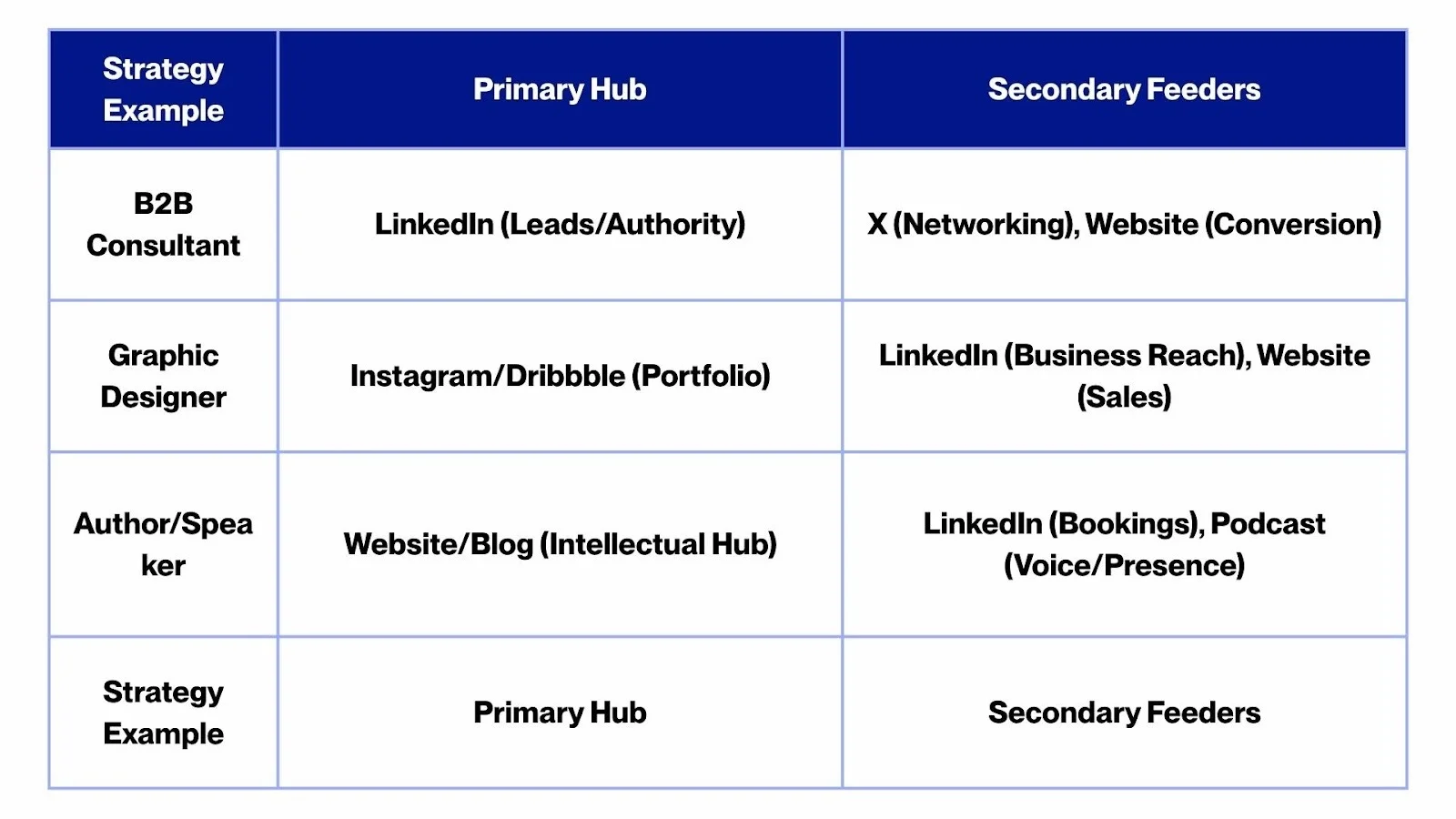
4. Determine Your “Core Platform” and Supporting Channels
Once you have your scores, clarify your resource allocation. It is far better to dominate one or two channels than to spread yourself thin across five.
- Core Platform (The Main Stage): This is where you focus the majority of your creation and engagement. It is your "flagship" home. A common 2026 power-combo is an Owned Hub (Website/Newsletter) paired with a Primary Social (LinkedIn or YouTube).
- Secondary Platforms (The Megaphones): These are used for distribution and networking. Use them to share snippets of your core content and drive traffic back to your hub. For example, use X to post "threads" that summarize a long-form article on your website.
- Minimal Presence (The Outposts): These are platforms where you maintain a professional profile and "listen" to trends (like Reddit or industry forums) without the pressure to post daily.
The Hub-and-Spoke Model
Strategically, view your owned site or newsletter as the Hub and your social channels as Spokes. The spokes catch the attention of a broad audience and funnel them toward the hub where you own the relationship.
Action: Decide on 1–2 Core Platforms and set a frequency (e.g., "One LinkedIn article per week"). Then, list 2–3 Secondary Channels and define their roles (e.g., "X for daily networking").
5. Develop a Content Plan (The "Pillar & Post" Strategy)
In 2026, efficiency is everything. Instead of creating new content for every platform, use a Pillar Strategy to maximize your output. This approach ensures your branding stays uniform while respecting the unique "vibe" of each platform.
- Create Pillar Content: Start with one "Big Idea" per week. This could be a deep-dive blog post, a 10-minute YouTube video, or a detailed newsletter.
- Deconstruct into "Micro-Content": * For LinkedIn: Turn 3 key takeaways into an educational carousel or a "short and sharp" text post.
- For X (Twitter): Break the pillar into a 5-tweet thread of quick-fire insights.
- For Instagram/TikTok: Film a 60-second "hook" explaining the most controversial or surprising point from your pillar.
- The 80/20 Value Rule: Ensure 80% of your posts provide value (educate, inspire, or entertain) and only 20% are promotional (asking people to buy a course, book a call, or sign up).
- Budget for Engagement: 2026 algorithms prioritize "Real-Time Personalization." Don't just broadcast; spend 15 minutes a day responding to comments and engaging with peers. Depth of interaction now outweighs simple like counts.
Action: Map out one "Pillar" for next week. List 3 ways you will "slice" it for your secondary channels.
6. Monitor, Learn, and Iterate
Treat your personal brand as a living experiment. The digital landscape moves fast, and your strategy should move with it.
- Track Metrics That Matter: Ignore vanity metrics (total followers). Instead, watch your Engagement Rate (comments/shares per post) and Referral Traffic (how many people actually click the link to your website).
- Perform a Quarterly Audit: Every 3–6 months, ask:
- Which platform is driving the most meaningful professional opportunities?
- Am I feeling "stretched too thin" on a platform that isn't yielding results?
- Is my "Owned Hub" (website/email) growing alongside my social following?
- Stay Adaptable: If a platform experiences "decay" or an algorithm shift that kills your reach, don't panic. Because you have an Owned Hub, you can simply shift your "Spokes" to a new platform where organic reach is higher.
Conclusion: Your Sustainable Ecosystem
In 2026, personal branding is not about being everywhere; it’s about being effective where it counts. By building on "Owned Land" and using social platforms as strategic funnels, you protect yourself from algorithm shifts and platform decay.
Focus on connection over collection. Whether you are a consultant, a creative, or a corporate leader, a well-balanced mix of LinkedIn, a personal website, and a direct-to-audience newsletter will ensure your brand remains resilient and visible for years to come. Not sure if your current platform mix builds authority or dilutes it? Ohh My Brand offers private audits to map the most effective, sustainable presence for your goals. Contact Ohh My Brand for more details today!


.svg)
.svg)
.svg)
.svg)



.svg)