



Personal Branding For Students
What Is Personal Branding For Students? How To Build Your Unique Story?
Personal branding isn’t just for CEOs, influencers, or job seekers. Students can and should cultivate their own brands too. In an era where college admissions officers and employers might Google you before an interview or acceptance, your personal brand often makes a first impression before you even say a word. Whether you’re a high school student applying to college or a college student stepping into internships, actively shaping how others perceive you can open doors that grades alone cannot.
In this guide, we will explore what personal branding means for students, why it is so important, and how you can start building a memorable personal brand right now. You will find actionable tips, examples of personal branding for high school and college students, and insights into crafting a personal brand statement that captures who you are. Owning your narrative can give you a significant competitive edge.
What Is Personal Branding ?(and Why Students Should Care)?
Personal branding is the practice of intentionally defining and promoting the image, qualities, and values that distinguish you. In simple terms, it is how people remember you, talk about you, and trust you. It is essentially your reputation and vibe in the minds of others. For students, your personal brand is shaped by everything from your behavior in class and extracurricular activities to your digital footprint on social media. Every post, comment, and interaction adds to the story people associate with you.
You might think branding is something you worry about later in your career, but even as a student you already have a personal brand. The question is whether you are intentionally building it or letting it develop on its own. Consider how friends introduce you or what teachers say about you. Those impressions are your brand in action. By being mindful of it now, you can steer that narrative in a positive direction.
Your personal brand can work for or against you in tangible ways. A strong brand showcases the unique story and traits that define who you are. It highlights what makes you unique, whether that is your passion for community service, your knack for coding, or your creative flair in art. When decision makers like college admissions committees or scholarship panels learn about you, your personal brand communicates why you are worth their consideration beyond just test scores or GPA. Personal branding is about owning your narrative so that others see the best, authentic version of you.
Why Personal Branding is Important for Students
Still wondering why personal branding matters for students? Here are five powerful reasons to start cultivating your brand while you are in school.
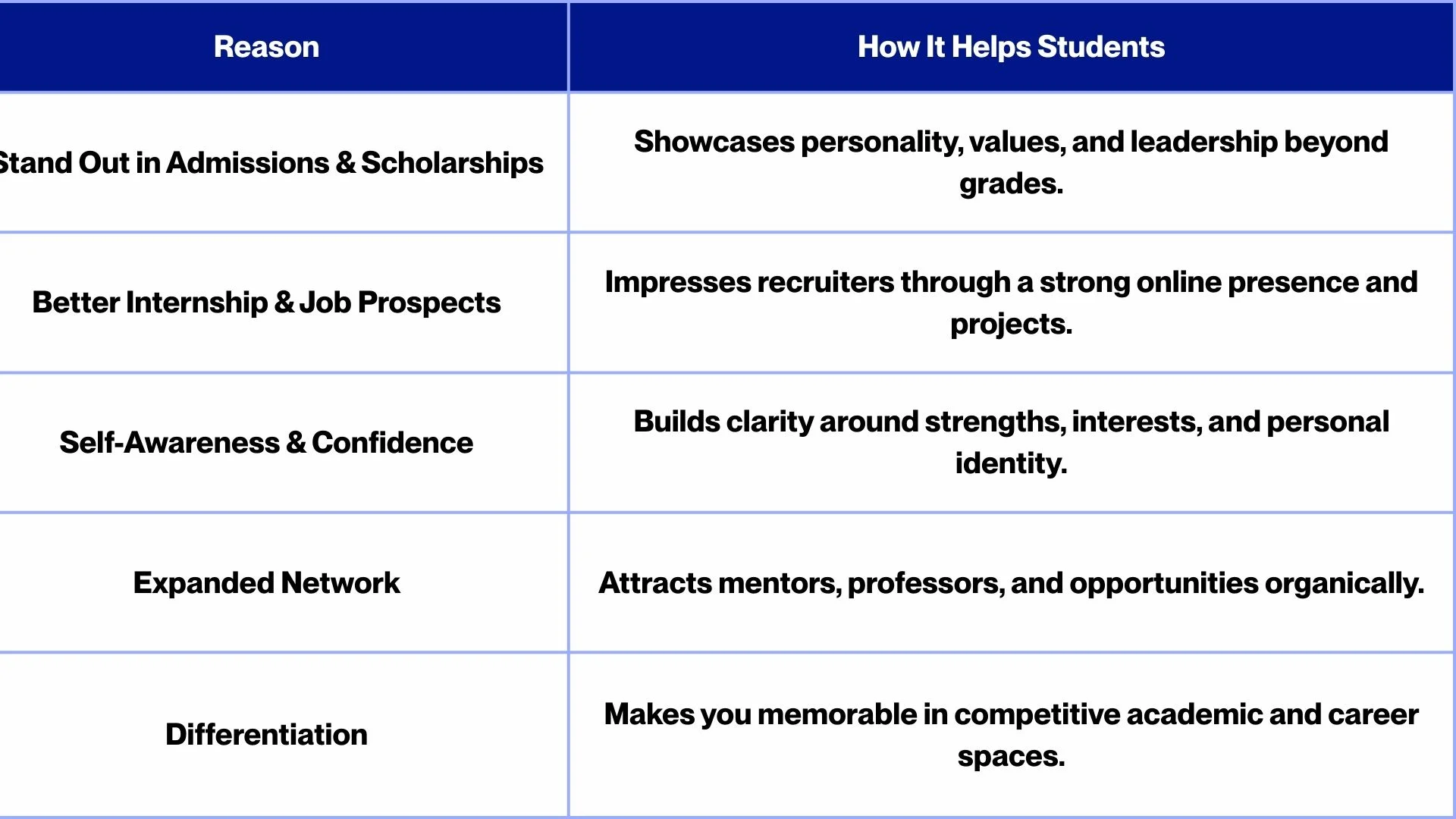
Stand Out in College Admissions and Scholarships
Getting into your dream college or winning scholarships takes more than good grades and test scores. Admissions officers want to know who you are and what you will contribute to their campus. Many admissions officers review applicants' social media profiles and factor online behavior into their decisions. They are looking for a well rounded picture of your interests, leadership, character, and values. A compelling personal brand helps you stand out by showcasing exactly what makes you unique and what you care about. It is the extra edge that can differentiate you from thousands of similar applicants. Your online presence and activities can essentially become a living supplement to your college application, painting a fuller portrait of you than grades alone.
Boost Internship and Career Opportunities
Personal branding does not stop at college. It sets the stage for career success. Employers routinely screen candidates online before hiring, and many have rejected candidates because of something found online. By developing a positive and professional brand as a student, you will impress recruiters and managers when you start seeking internships or jobs. For example, a robust LinkedIn profile, a personal project portfolio, or a history of thoughtful blog posts can catch a recruiter’s eye and serve as proof of your skills and initiative. In a sea of resumes, a clear story of what you are about can be the tiebreaker that lands you an interview. It is never too early to lay that groundwork.
Develop Self-Awareness and Confidence
Building your personal brand requires you to reflect on who you are, what you stand for, and what your strengths are. This process is incredibly valuable for personal growth. By identifying key values, interests, and traits, you gain clarity on your identity. That self-awareness boosts your confidence because you learn to articulate what makes you unique and why that matters. When it comes time to write admissions essays, introduce yourself in interviews, or network with others, you will be able to convey a clear and authentic story. Personal branding forces you to know yourself, which helps you present yourself with genuine passion. That confidence is attractive to colleges, employers, and collaborators alike.
Expand Your Network and Opportunities
A well-crafted student brand can organically attract like-minded people and mentors into your network. By putting your interests and goals out there, you signal to others what you are about. People who share your passions or who are impressed by your initiatives may reach out with opportunities. Maybe a professor notices your tech blog and invites you to help with research, or a local business offers you an internship after seeing your volunteer project on LinkedIn. Personal branding is essentially marketing yourself. In every internship, job, or conversation, you are subtly selling your story and potential. Being proactive about your narrative helps the right people find and remember you. Doors tend to open when you are on people’s radar for positive reasons.
Differentiate Yourself in a Crowded Field
Whether it is college admissions, internships, or even competitive student programs, there are many candidates with similar credentials. Your personal brand is what makes you memorable. It communicates at a glance what you bring to the table that others might not. Maybe you are the aspiring environmental scientist who founded a recycling initiative at school, or the budding entrepreneur who already launched a small online business in college. Those are brand identities that stick. Being able to articulate your unique story and value means you will not blend into the background. By simply showing up with intention and consistency, you can build a reputation that people associate with something specific and positive. This not only helps you get selected for opportunities but also builds trust so people think of you when relevant opportunities arise.
Personal branding is important for students because it gives you control over your narrative and a head-start in an increasingly competitive academic and professional world. It is about making sure when others hear your name, they have a clear and positive idea of who you are.
Personal Branding for High School Students
Personal branding might sound ambitious for a teenager, but high school is actually the perfect time to start. If you are college bound, you already know the landscape is competitive. Admissions officers nowadays look beyond grades and test scores because they want to understand your personality, values, and impact. Your personal brand can convey those elements effectively. Studies show that a majority of admissions officers consider an applicant’s online presence fair game in the evaluation process. They are searching for your name and checking what story your digital footprint tells. This means your social media, search results, and overall online persona are part of your application. You can also look for: Best Personal Branding Books.

Curate Your Online Presence
Before application season, take time to audit your social media and clean up your digital footprint. Remove any posts, photos, or comments that do not reflect the mature, positive image you want to present. Honestly ask yourself if you would be okay with a college admissions officer or your favorite teacher seeing each post. Privacy settings are your friend. You might keep personal accounts private and create a more professional or hobby focused public profile. Also consider Googling yourself regularly to see what comes up. The goal is that when colleges look you up, they find content that highlights your strengths rather than raises red flags.
Showcase Your Passions and Achievements
Think about what story you want your brand to tell. Make sure the things you are proud of and care about are visible. For example, if you love volunteering, post occasionally about your community service projects. If you are a budding artist or coder, consider creating an online portfolio or personal website to show off your projects and talents. Many admissions officers check social profiles to learn about candidates beyond the application, so use that chance to your advantage. Share photos of a science fair where your project won an award or a debate competition you participated in. These posts paint a picture of a motivated, involved student. Admissions teams notice students who use social media in creative ways to document their genuine interests.
Demonstrate Character and Leadership
Colleges are looking for students who will add value to their campus. Your personal brand should reflect qualities like leadership, initiative, and resilience. You can highlight this by telling short stories about your experiences. For instance, maybe you started a study group to help classmates in math. That shows leadership and community spirit. Perhaps you overcame a challenge like learning a new skill or improving your grades in a tough subject. Sharing what you learned from it shows maturity. Use your online presence to communicate how you help others and how you grow through challenges. A simple post about mentoring younger students at the library signals your values. These narratives make you more than just a GPA and show you are a person who will enrich a college community.
Align Activities with Your Personal Story
Personal branding for high schoolers is not just online. It is also in the activities you choose and the way you talk about them. Identify one or two core themes or passions that define you, such as science and healthcare or writing and social justice. Then seek out or highlight activities that reinforce those themes. Depth often matters more than breadth. If you are a science enthusiast, you might take extra science courses, join the STEM club, and volunteer at a local museum. By focusing on what genuinely interests you, you will naturally build accomplishments in that area. This makes it easier to craft a clear narrative. You cannot be everything at once, so home in on what excites you most and lean into it.
Craft a Personal Brand Statement for College Applications
As you prepare resumes or personal statements, it helps to have a concise personal brand statement. This is a short summary of who you are and what you aim to do. This can be one or two sentences that capture your essence. For example, a student might describe themselves as a curious science enthusiast aspiring to a career in medicine who enjoys helping others and excels as a competitive athlete. In just a few lines, this communicates passion, a service orientation, and a driven personality. Another student might highlight a unique mix of interests like cinematic arts and exercise science. These statements go beyond grades to tell a story and show vision. Try writing your own by thinking about your key qualities and the future you are working toward.
Personal branding in high school should remain authentic and balanced. You are still a teenager, and it is not about projecting a false image or chasing online fame. It is about presenting your best self. Do not worry if you are not winning national awards. Colleges just want to see the real you shining through. Focus on being yourself with intention. Be mindful of how you present yourself, keep it positive, and let your genuine interests and character take center stage.
Personal Branding for College Students
By the time you are in college or a recent graduate, personal branding becomes both easier and more crucial. You have more experience defining your brand because college students often juggle academics, clubs, part-time jobs, and internships. These all contribute to your story. At the same time, the stakes are rising. You are approaching the job market or grad school applications where a strong personal brand can set you apart.
Professionalize Your Online Presence
If you have not already, create or refine your LinkedIn profile as a cornerstone of your personal brand. Use a professional looking photo and write a headline that goes beyond your status as a student. For instance, highlight your field of interest or key skills such as computer science student and aspiring data scientist. Fill the summary section with a brief personal branding statement or mission. Consistency across platforms is important. Make sure your LinkedIn, professional social media, and personal blog present a coherent image of who you are. If an employer or networking contact Googles you, they should get a unified impression. Also take the time to scrub any remnants of just for fun social media posts from years past that you would not want a recruiter to see. Managing your online reputation like a pro is part of the process.
Showcase Your Work and Expertise
Think of your personal brand as a portfolio of your best work and accomplishments. By college, you likely have tangible projects to show. If you are an engineering student, share your design project or hackathon prototype on a personal website or GitHub. If you are a writer or marketing student, maintain an online portfolio of articles or campaign ideas. The idea is to back up your skills and passions with evidence because proof builds credibility. You do not need a fancy title to have credibility. You just need to show your work. Each project, internship, or leadership role can become a story that reinforces your brand. Write a blog post about what you learned in a research project or share a case study of a group project you led. By putting your experiences out there, you demonstrate initiative rather than just claiming to be skilled.
Network Authentically
Personal branding is not just broadcasting your own story. It is also about engaging with others and building relationships. The best brands spark conversations rather than just self promotion. As a college student, start connecting with peers, professors, and industry professionals in your field. Attend networking events, join professional associations, and be active in those communities. Online, engage on LinkedIn by commenting thoughtfully on posts related to your field or sharing interesting articles with your own take. These interactions help get your name known and show that you are supportive and plugged into your industry. Mentorship can be a big boost, so do not hesitate to reach out to professors or alumni for guidance. Connections you make in college can lead to job referrals or collaborations down the line.
Position Yourself as a Budding Thought Leader
You can establish a reputation in your niche even as a student. If you are extremely enthusiastic and knowledgeable about a topic, leverage that by creating content and leading conversations. This could mean starting a blog, a video series, or a campus podcast. Share insights from what you are learning in classes or internships. You could do a breakdown of a recent news event related to your field or offer tips to fellow students. When you consistently create value for others in a specific domain, you gradually become seen as an informed voice on that subject. You do not need thousands of followers. Even within your campus or a small network, this consistent presence builds your brand authority. People might start associating you with that field and recommending you for related opportunities. Authority builds over time and demonstrates a high level of commitment to employers.
Evolve and Adapt Your Brand as You Grow
Your brand is dynamic and evolves as you gain new experiences. Unlike a static resume, your personal brand is a living image that you can refine continuously. Do not be afraid to pivot or update your narrative if your interests change. If you started college as a pre-med student but discovered a love for computer science, it is authentic to shift your brand to reflect that. Just ensure your platforms and messaging reflect the change. The key is still consistency. Even if the content of your brand changes, stay consistent in how you present the new focus across all channels. Being adaptable is a strength that shows you are growing. As you near graduation, you will likely fine tune your brand to align closely with the industry or roles you are pursuing.
Personal Branding Activities for College Students
Audit Your Social Media and Google Results
Clean up anything unprofessional and use your accounts to reflect your interests. Share your accomplishments on LinkedIn and ensure your privacy settings on other platforms are tightened. Many professionals look at public profiles, so portray the image you would want an employer to see.
Create a Personal Website or Portfolio
A simple website with your resume, projects, blog posts, and contact information can greatly elevate your professional image. It acts like an extended business card. You can easily build one using various online platforms. Having your own site allows you to control the narrative so that when someone searches your name, your site is the top result showcasing your best work.
Engage in Relevant Extracurriculars
Join clubs, competitions, or volunteer work that align with your desired brand. If you want to be known in finance, for example, being active in an investment club or participating in a case competition will reinforce that identity. Mention these experiences online to strengthen your professional story further.
Practice Writing Your Pitch
In college, you will need to introduce yourself at interviews and networking events. Practice a thirty second personal pitch that encapsulates your brand, including who you are, what you are skilled at, and what your goals are. This pitch is your personal brand in spoken form. Having it ready ensures you leave a strong impression when meeting new people.
Leverage Career Services or Mentors
Your campus likely has resources to help you craft your brand. Take advantage of resume workshops, LinkedIn profile critiques, and mock interviews to help articulate your value. Some universities even offer professional development seminars. Use these to refine how you present yourself and seek feedback from your network to improve.
By implementing these steps, you will enter the professional world with a clear and polished personal brand that authentically represents you. It is much better to experiment and learn to brand yourself while you are still a student than to wait until you are job hunting under pressure. Managing your personal brand now will pay dividends throughout your career.
How to Start Building Your Personal Brand (Step-by-Step)
No matter your age or stage, the fundamentals of building a personal brand as a student remain similar. If you are feeling overwhelmed, here is a simple step-by-step approach to get started.
Choose Your Lane
Begin by deciding what you want to be known for. You cannot be known for everything, so focus on one or two key areas that genuinely interest you. Ask yourself what topics or fields light you up the most or what skills you want to highlight. This will be the thematic focus of your brand, whether it is music, environmental activism, robotics, or creative writing. Clarity here will make all other steps easier.
Audit Your Current Presence
Take stock of how you currently appear to others. Google yourself and see what comes up. Review all your social media profiles as if you were an outsider. Consider what impression a stranger, an admissions officer, or an employer would get from your profiles. Clean up any content that does not fit the image you want to project. Ensure your bios, profile pictures, and even your email address are aligned with your professional brand. A simple email with your name is much better than a goofy nickname when you are contacting colleges or potential employers.
Define Your Brand Attributes
Take time to write down the elements of your personal brand. This can include your strengths, values, passions, key personality traits, and goals. Try to pinpoint what differentiates you from others. A great exercise is to ask close friends, family, or mentors how they would describe you because others often see patterns in you that you might overlook. Collate this information and formulate a personal brand statement. For example, your brand might be a tech enthusiast who loves solving healthcare problems and values community service. This gives you keywords and themes to consistently emphasize.
Create or Update Your Content
Start building a body of evidence that supports your brand. This could be as major as launching a personal blog or as simple as regularly posting insights on LinkedIn. If you have not already, create a LinkedIn profile and fill it out thoroughly as an evolving resume and mission statement. If you have projects like school assignments, personal side projects, or research papers, consider linking to them. You do not need to do everything at once. You can start by writing a short article about a topic you learned or making a video tutorial for something you are good at. Each piece of content acts like a brick contributing to the structure of your public image.
Engage and Connect
Building a brand is a social endeavor, not a solo broadcast. Start engaging with others in your chosen lane. Comment on posts or articles related to your field, join clubs where your interests are discussed, and connect politely with people who share your goals. Aim to contribute value in these interactions by answering questions or sharing useful resources. Consistency is key. Show up regularly, even if it is just one thoughtful comment a week. Over time, these actions reinforce that you are actively involved in your space and keep you on the radar of others.
Monitor and Evolve
Every so often, step back and assess how your brand is developing. Keep track of positive feedback or wins, such as a shoutout from a teacher or a blog post that received high engagement. These are signs your brand is gaining traction. At the same time, pay attention to any areas where you might be sending mixed signals. Your personal brand is a continuous project, so it is okay to fine tune it. As you gain new experiences, integrate them into your story. Think of yourself as the manager of your own image and check in periodically to ensure you are on the right track.
The key to personal branding is starting small and staying consistent. Even posting one update a month can be a great start. Over time, these small actions compound into a strong presence. You do not need to have everything figured out to benefit from this process. You just need the courage to show up intentionally and tell your story.
Crafting Your Personal Brand Statement (with Examples)
A personal brand statement is a short, punchy phrase or sentence that sums up your unique value and identity. Think of it as your tagline or a one-sentence mission statement. Crafting one is a useful exercise because it forces you to distill what matters most about you. You can use it in your social media bios, resumes, or as an elevator pitch when introducing yourself.
How do you write a good personal brand statement as a student? Here is a simple method.
Reflect on Key Questions
Ask yourself things like: What is my passion or career goal? What skills or strengths do I bring to the table? What values or qualities make me different? Jot down answers freely. If you are stuck, think about what friends or mentors have complimented you on, such as being great at explaining math, being creative, or being an empathetic leader.
Write a Short Paragraph
Start by writing a few sentences that weave together your answers. Do not worry about length or perfection initially. Include who you are, what you aspire to do, and how you want to make a difference. For example, an engineering student might write about their love for robotics and AI and their belief in using technology to improve healthcare. This provides a solid foundation to build upon.
Trim it Down
Take that rough paragraph and condense it. Highlight the most important phrases, likely a combination of your role, your key strengths, and the impact you aim to have. Try to get it down to one strong paragraph or two concise sentences. You might describe yourself as an engineering undergrad passionate about robotics and using technology to solve real-world healthcare challenges. This version is perfect for a LinkedIn summary or a resume profile.
Create a One-Liner
Now extract the essence into one catchy line. This becomes your slogan or tagline. It should intrigue the reader and capture your vibe. An engineering student might say they are a tech innovator on a mission to improve healthcare. For a marketing student, it could be storyteller and aspiring brand builder. This one-liner can go in your email signature or social media bio.
Personal Brand Statement Examples
The exact format is not as important as the content and consistency. Use your statement everywhere it is relevant. Here are a few examples for different student paths:
- For a Future Educator: Changing lives through education. This conveys impact and a clear field of interest.
- For a UX Designer: Aspiring UX Designer blending psychology and art to create intuitive, human-centered apps. This shows a unique perspective and a specific goal.
- For an Advocate: First-generation college student determined to advocate for healthcare access through technology and policy. This highlights personal background and a clear mission.
- For a College Applicant: I am a curious, hard-working science enthusiast aspiring to pursue a career in medicine. I enjoy helping others and look forward to growing as a learner. This version is slightly longer but works well for applications.
Your personal brand statement can evolve. Update it as you discover new passions or achieve new accomplishments. The goal is to always have a current, compelling answer to the question "tell me about yourself" that you can share confidently and authentically.
Will Personal Branding Really Help Students?
You might be thinking that this sounds like a lot of work and wondering if personal branding is truly worth it. The answer is a resounding yes. Personal branding is not a vanity project; it is a practical tool for success. Here is why it absolutely works for students.
It Is Already Happening
Whether you consciously work on it or not, you have a reputation. Teachers, peers, and online acquaintances already have perceptions of you. You already have a brand in their eyes. By taking charge of it now, you ensure that your reputation aligns with what you want. It is much better to shape it intentionally than to leave it to chance.
Real Opportunities Result
Admissions officers and employers respond to personal brands. There are concrete examples of students who gained scholarships, internships, or job offers directly because of their proactive personal branding. When you put effort into showcasing your best self, people notice and doors open.
Competitive Edge
Think of personal branding as building leverage. If two students have similar grades and resumes, but one has a clear online presence that shows extra initiative or personality, that student is more memorable. Many students will not bother with this, so if you do, you are immediately ahead. It is a way to set yourself apart from the crowd with minimal extra effort.
Lifelong Skill
Learning to brand yourself is a skill you will use for life. In every stage, such as applying to grad school or vying for promotions, you will need to communicate who you are and what value you bring. By practicing early, you build communication skills and self-promotion savvy. You become comfortable marketing yourself, which is a significant advantage in any professional situation.
Self-Motivation and Accountability
Working on your personal brand can motivate you to become the person you want to be. When you declare your goals and values publicly, you are more likely to hold yourself to them. It acts like positive pressure from your future self. As you achieve what you set out in your brand, your confidence grows even more.
Personal branding empowers you by putting you in the driver’s seat of your narrative. It will not replace hard work, but it will amplify your efforts and ensure they are seen by those who matter. Authenticity is the cornerstone of a good brand. This is not about inventing a persona; it is about highlighting the best of your real self.
Conclusion: Start Owning Your Narrative Today
Personal branding for students boils down to taking charge of how the world sees you before someone else defines it for you. In a digital age where first impressions are often made online, students who actively craft their brand have a clear advantage. You do not need to be a straight-A student or have a prestigious title; you just need to show up with intention and consistency.
Here are the essentials to remember:
- Know yourself: Reflect on your strengths, passions, and what makes you unique.
- Build your presence: Create and curate content that tells your story across social media and personal websites.
- Stay consistent and professional: Align your online and offline behavior with the image you want to project.
- Be authentic: Let your true personality and values shine through.
- Engage and connect: Use your brand to forge meaningful relationships and nurture your network.
- Evolve as you grow: Adapt your brand as you discover new interests and move through different stages of your education.
By starting now, you are investing in yourself. Think of it as planting a seed that will grow into a strong, recognizable presence by the time you graduate. This can lead to tangible outcomes like college acceptance, job offers, or a reputation you are proud of.
Ask yourself what you want to be known for and if you are showing that to the world. If not, start today. Even a small step like writing a mission statement or sharing an article can set things in motion. Your personal brand is your narrative. Take ownership of it now and make that story count. Contact OhhMyBrand today to learn more about how to transform your name into a brand that opens doors. Let’s work together to make you not only visible but unforgettable in your field.



.svg)
.svg)
.svg)
.svg)



.svg)