



LinkedIn Thought Leadership
LinkedIn Thought Leadership: Strategies for Tech Executives to Stand Out
Introduction
In today's hyper-connected world, LinkedIn isn't just a networking site; it's the global stage for professional thought leadership. For tech executives and entrepreneurs, a strong personal brand on LinkedIn can be the difference between blending in with the crowd or becoming a go-to industry voice. In fact, executives worldwide attribute up to 43% of their company’s market value to the CEO’s reputation.
This underscores how much your personal brand and credibility can impact business success. If you’re a tech leader, it's time to leverage that influence where it counts.
Building thought leadership on LinkedIn is about more than self-promotion; it’s about sharing insights, demonstrating expertise, and building trust at scale. A recent LinkedIn survey found that 78% of executives believe their personal brand helps attract top talent, and 56% say it positively impacts their company’s bottom line. Clearly, your presence on LinkedIn isn’t just about you; it can boost your company’s growth and reputation too.
Yet many tech CEOs, CTOs, and founders hesitate to post or engage on LinkedIn. Some worry about coming off as “braggy,” while others simply lack the time. That’s where a specialized LinkedIn agency for tech executives comes in. Personal branding agencies like Ohh My Brand (co-founded by Bhavik Sarkhedi and Sahil Gandhi) exist to help busy tech leaders craft a compelling LinkedIn presence.
Bhavik Sarkhedi, a serial entrepreneur and Forbes Global Branding Expert, has built 160+ personal brands across 14 countries. His co-founder, Sahil Gandhi, is a renowned brand strategist who helps founders craft sharp, scalable brands with clear messages that cut through the noise and spark action. Together, their agency, Ohh My Brand, has one mission: to turn unknown professionals into known thought leaders.
In this blog post, we'll break down effective strategies for tech executives to stand out on LinkedIn. From profile optimization to content strategy, we'll cover how to establish yourself as a LinkedIn thought leader.
Along the way, we’ll see real examples of how embracing personal branding (with a little help from LinkedIn experts at Ohh My Brand) can translate into tangible opportunities. By the end, you’ll have a clear roadmap and plenty of motivation to elevate your LinkedIn game and start reaping the rewards of a powerful personal brand.
Strategy Breakdown
So, how can a tech executive build real thought leadership on LinkedIn? Let’s dive into the key strategies, step by step.
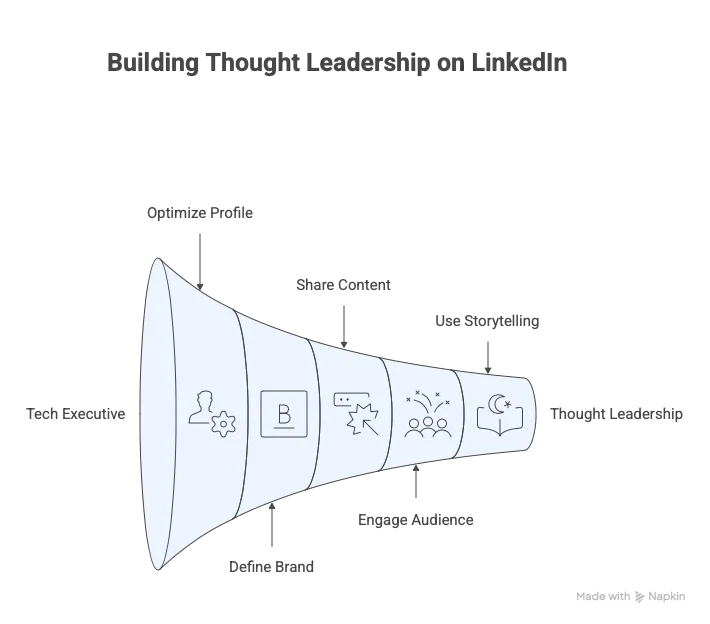
1. Optimize Your LinkedIn Profile as Your Digital Business Card
Your LinkedIn profile is the first impression you make on the platform; think of it as your digital business card and personal landing page. Start with the basics: a professional headshot (ideally, a friendly close-up with good lighting) and a headline that goes beyond your job title. Instead of just "CTO at XYZ Corp," craft a headline that shows the value you offer or highlights your niche (e.g., "CTO | Driving AI Innovation in Healthcare" or "Tech Executive & IoT Thought Leader"). This instantly tells visitors who you are and what you’re about.
Make sure to fill out the About section with a concise, story-driven summary of your career, mission, and accomplishments. Speak in the first person and let your personality shine through; this is a chance to be conversational and human, not just list a resume. Keywords are important here for SEO (use terms like "personal branding," "technology leadership," and "your technical specialties"), but focus on storytelling and impact.
For example, share why you're passionate about your field or a defining career moment that shaped your leadership philosophy. Authenticity is key: remember, people connect with people, not corporate jargon.
Don’t neglect the visual and credibility elements of your profile. Customize your LinkedIn banner image, perhaps with a relevant graphic or tagline, to reinforce your personal brand. Update your experience with not just roles, but a sentence or two about what you achieved in each position. And definitely add any public speaking, publications, patents, or awards in the Featured section if you have them. These social proof elements bolster your authority at a glance.
Pro tip: A LinkedIn expert from a personal branding agency like Ohh My Brand can audit and revamp your profile to ensure it's not only complete but truly compelling. Often, they’ll identify strengths you overlooked and help phrase your value proposition in a way that attracts the right audience. The goal is a profile that immediately signals, "This tech leader knows their stuff, and they have a vision."
2. Define Your Personal Brand and Niche
To stand out as a thought leader, you need to stand for something. Take time to define your personal brand ethos and the niche topics you want to be known for. Are you the cybersecurity evangelist? The AI-for-good advocate? The SaaS growth guru? Identify the intersection of your expertise and passions that is most relevant to your industry. This focus will guide all your LinkedIn activities, from the content you post to the people you connect with.
Start by clarifying your core message and values. Perhaps you believe in using technology to improve healthcare outcomes, or you champion remote work culture in tech teams. Whatever it is, weave that narrative consistently through your profile and content. Consistency builds recognition.
As Ohh My Brand co-founder Sahil Gandhi emphasizes, crafting a clear message that cuts through the noise is essential to scalable branding. When your audience repeatedly sees you talking about, say, AI ethics or fintech innovation, you become associated with those topics in their minds.
Being niche doesn’t limit you; it distinguishes you. Specificity attracts the right people. Share insights that are specific to your domain; this draws in followers who truly care about that subject and positions you as an expert in that space.
For example, instead of a generic post about "leadership," a cloud computing executive might share lessons on leading distributed engineering teams, or a healthtech founder might post about navigating data privacy in medical AI. These focused topics resonate more deeply with the people who matter most to your goals.
Remember, your personal brand also includes your tone and style. Maybe you’re analytically minded and data-driven, or maybe you’re a visionary storyteller. Lean into that. Are you the bold provocateur challenging industry norms or the friendly mentor sharing advice?
Embrace a style that is authentic to you. This authenticity is what makes your thought leadership believable and relatable. Authenticity wins on LinkedIn; sharing genuine insights and even failures can actually make your voice more trustworthy and memorable. Define what you want to be known for, stay true to yourself, and soon your name will be synonymous with your chosen niche.
3. Consistently Share Valuable Content (Quality and Consistency Matter)
With your profile polished and your niche defined, it’s time to start posting content and do so consistently. Consistency is perhaps the secret sauce of LinkedIn thought leadership. You don’t need to go viral to make an impact; you just need to show up regularly. Posting insightful content even once a week can keep you on your network’s radar and gradually position you as a familiar voice in the field. In fact, consistent posting creates visibility over time, opening the door for unexpected opportunities, even if each individual post doesn’t explode in reach.
What kind of content should you share? Aim for value-packed posts that cater to your audience's interests and pain points. As a tech executive, you have a wealth of experience; share it. You could post short industry analyses, commentary on tech news, leadership lessons from your own career, or even behind-the-scenes glimpses of your projects or startup life. Practical how-tos, trend insights, or lessons learned from failures are pure gold.
One tip is to share the kind of advice you wish you'd had a few years ago when you were in a slightly more junior role. These insights are likely to help those a step or two behind you (and even impress peers who appreciate your depth of understanding).
Mix up your content formats to keep things interesting: text posts, informative slide decks, short videos, or even the occasional poll to encourage interaction. Whatever the format, make sure your content is authentic and human. Speak in a conversational tone (just like we're doing in this blog) rather than using stiff corporate speak.
Thought leadership doesn’t mean sounding academic; it means offering perspective. If you struggled with a technical challenge and solved it, share that story and what you learned. If you have an opinion on emerging tech (e.g., "Why I think the XYZ AI trend is overhyped"), don't be afraid to put it out there. Having a point of view is what makes thought leaders stand out from the sea of generic posts.
Crucially, engage quality over quantity. It's better to post once or twice a week with thoughtful content than to post daily with fluff. Each piece you share should aim to either educate, inspire, or spark a conversation. Over time, as people see you consistently giving value without asking for anything, you'll build an audience that trusts and respects your expertise.
And yes, people are watching quietly even if they don’t interact right away. Several professionals have landed clients or career opportunities from folks who had been silently following their content for months. By posting regularly, you ensure that when that potential investor, employer, or partner finally needs someone with your insights, your name pops up in their mind first.
(And if you’re too busy to post consistently? That’s again where a team like Ohh My Brand can help; they can ghostwrite thoughtful posts in your voice and keep your content calendar running like clockwork. Many LinkedIn agencies offer content creation services tailored to executives, so you maintain consistency without the stress.
4. Engage with Your Audience and Industry
LinkedIn isn’t a one-way broadcasting platform; it’s a community. Engagement is a two-way street, and as a thought leader you elevate your presence not just by what you post, but by how you interact with others. This means taking the time to respond to comments on your posts, commenting on others’ content, and participating in discussions in your field. These interactions humanize you and expand your visibility beyond your immediate followers.
When someone leaves a thoughtful comment on your post, reply to them. Even a simple “Thank you for sharing your perspective” or answering their question can foster loyalty. It shows that you’re present and listening. Moreover, don’t be afraid to pose questions in your posts to invite dialogue. For example, a tech CEO might conclude a post about a new AI breakthrough with, "I'm curious, how do you see this playing out in your industry?" Such prompts encourage others to chime in, boosting your post's engagement (and reach, thanks to LinkedIn’s algorithm) while positioning you as a conversation starter.
Engaging with others’ posts is equally important. Follow other leaders in your domain and regularly drop insightful comments on their content. This isn’t about leaving generic praise; add your take or build on their point. If a fellow tech executive posts an opinion on, say, remote work policy, you might comment with your own experience or a respectful counterpoint.
Thousands of people might see that post, and your comment, if it stands out, is essentially a mini thought leadership moment introducing you to a new audience. It’s not uncommon for proactive commenters to gain new connections and followers because someone appreciated their take in a comment thread.
Another way to engage is by joining LinkedIn Groups relevant to tech and your interests, or even starting your own.
While groups have lost some luster in recent years, niche communities can still be great for networking. Additionally, consider networking strategically: connect with peers, industry journalists, conference organizers, and even up-and-coming professionals in your field. Personalize connection requests with a note about why you admire their work or that you share mutual interests; this increases the chances of acceptance and a meaningful connection. Over time, as your network grows, so does your influence.
Always remember Dale Carnegie’s classic principle: to be interesting, be interested. Show genuine interest in others on LinkedIn, celebrate their wins, endorse skills you truly know they have, and share others’ great content occasionally (with credit).
Supporting others’ thought leadership doesn’t diminish yours; it actually amplifies your credibility as a community leader. And practically speaking, engaging regularly signals the LinkedIn algorithm that you’re an active contributor, which can further boost the visibility of your own posts.
5. Leverage Brand Storytelling and Authentic Voice
Every tech leader has a story, and sharing yours in an authentic way is a powerful differentiator. We often think of "thought leadership" as sharing big ideas or expertise (which it is), but it’s also about letting people get to know the person behind the expertise. This is where storytelling comes in.
When you tell a compelling story, whether it's about a tough lesson, a mentor who inspired you, or a mistake that taught you more than any success, you create an emotional connection with your audience. That connection is what turns a passive reader into an engaged follower.
Don't shy away from being personal (within professional bounds). For instance, a CTO might share how tinkering with a Commodore 64 as a kid sparked a lifelong passion for coding, or an entrepreneur might recount the moment their startup nearly ran out of cash and what they learned as a leader in that crisis. These narratives do two important things: they humanize you, and they impart wisdom.
People remember stories far more than they remember a list of facts. If you can wrap an insight or piece of advice in a relatable story, you'll find it resonates much more. In fact, sharing failures or challenges you've overcome can build immense trust; it shows authenticity and confidence. As multiple LinkedIn success stories have shown, being real about your journey (the good and the bad) makes you memorable and builds trust.
Additionally, let your natural voice shine through in your writing. If you have a sense of humor, sprinkle that in. If you’re passionate about something, let your enthusiasm show. The goal is for someone reading your posts to almost hear you speak through the text. This distinct voice is part of your personal brand.
In a world where there’s plenty of stiff, cookie-cutter content (and increasingly, AI-generated posts), sounding like an actual human is an advantage. Don’t polish away your personality. A touch of vulnerability or humor can make your thought leadership content stand out like a lighthouse in a sea of generic corporate updates.
Let's not forget, storytelling can be supported with data or visuals too. If you have interesting data points from your company or industry, share the story behind the numbers (e.g., "Our user base doubled in three months after we changed X; here's what that taught us"). Or use an analogy or metaphor to explain a complex tech concept; this is a form of storytelling that educates while keeping readers hooked.
The bottom line: be authentic, be relatable, and share the “why” and “how” behind what you do, not just the “what.” This approach transforms you from just another tech expert into a leader people feel connected to. And when people feel they know you, they're far more likely to engage with your content, champion your ideas, and even extend opportunities to you.
6. Consider a LinkedIn Agency or Expert Help for Tech Executives
What if you understand all these strategies, but you simply don’t have the bandwidth to execute them consistently?
This is a common scenario for busy tech executives. Crafting a personal brand takes time and sustained effort, which can be challenging when you're juggling product roadmaps, investor meetings, and team management. If that's the case, partnering with a LinkedIn agency for tech executives might be your game-changer.
Specialized agencies like Ohh My Brand exist to do the heavy lifting for you. They bring in a team of content strategists, writers, and branding experts who understand both the tech industry and LinkedIn’s nuances.
How can they help? For starters, they can formulate a personalized content strategy aligned with your goals, whether it's attracting talent, gaining speaking gigs, or simply increasing your industry influence. They’ll identify the topics and post formats likely to resonate in your niche, ensuring you put out content that hits the mark.
Agencies also excel at profile optimization (making sure your profile is polished to perfection and rich in the right keywords), as well as managing your posting schedule. With an agency’s support, you could have a steady flow of well-crafted posts, articles, and even LinkedIn newsletters, all created with your voice and perspective but without you having to draft each one from scratch.
Essentially, they act as your ghostwriters and branding coaches, letting you focus on your core job while your LinkedIn presence grows in the background.
Consider an example: Ohh My Brand has an entire portfolio of success stories where they've turned clients into thought leaders.
They helped one author and speaker align his scattered digital presence and even land a coveted contributor spot on Forbes, dramatically increasing his credibility. If agencies can do that, imagine what they can do by focusing specifically on your LinkedIn impact. Co-founders Bhavik Sarkhedi and Sahil Gandhi have built a team with expertise in LinkedIn reputation management, content creation, SEO, and PR, giving their clients a one-stop solution to amplify personal brands.
As Bhavik likes to put it, they take you "from unknown to known," positioning you as the go-to expert in your field (a mantra echoed in Ohh My Brand’s own mission statement).
Of course, choosing to work with an agency is a personal decision. You can certainly achieve LinkedIn growth on your own. But if you view your personal brand as an investment, something that can yield returns in the form of opportunities and business growth, then bringing in experts can accelerate the process.
Think of it like hiring a personal trainer for your brand: you still do the thinking and engage authentically, but they guide the strategy, keep you consistent, and ensure you’re using best practices.
For many tech leaders, that guidance and time-saving is invaluable. It can mean the difference between sporadic effort (that might fizzle out) and a sustained, professional approach that truly elevates their profile.
Real Examples and Case Studies
To really drive home the impact of LinkedIn thought leadership, let’s look at some real-world examples and success stories. These cases show how embracing personal branding, either solo or with an agency’s help, can lead to tangible results for tech executives and professionals.
- From Invisible to VP of Marketing: One marketing professional admitted that for years she “had the wins and the experience but didn’t have the visibility.” She was hesitant to put herself out there on LinkedIn, fearing the spotlight.
But once she started regularly posting her insights and behind-the-scenes lessons, things changed. Within a year, she landed a new role as a VP of Marketing at a tech company directly thanks to the visibility her LinkedIn activity gave her. Her content also sparked a flood of incoming requests from people who had been quietly following her, asking for help with their own personal brands.
This story shows that opportunities often come from those silent lurkers in your audience who’ve grown to respect your voice. If a new executive role or consulting gig is on your wish list, building your LinkedIn presence can absolutely make it happen.
- Co-Founding a Startup via LinkedIn: It’s not just jobs; even companies can be born from LinkedIn connections. In one remarkable case, a content marketer consistently shared honest, value-driven posts about what was working (and not working) in his field.
He later received a message from someone who had been following his posts for a while. That person first became a client and then eventually proposed teaming up to launch a new SaaS product together. Six months later, they co-founded a startup all because of a LinkedIn connection that began with content and mutual respect.
This example underlines how powerful your content can be in attracting like-minded partners. By putting your authentic ideas out there, you essentially broadcast your “bat signal” to others who share your vision.
- Attracting Clients and Partnerships: There are numerous stories of tech consultants or founders who have drawn significant business through LinkedIn. For instance, one founder shared that after she consistently posted about her approach to marketing and brand voice, a dream client reached out to her via direct message.
They told her, “Your posts sound like you get it,” and that was enough for them to start a business relationship. In another example, a business development director landed a major partnership with a Fortune 500 company (Nestlé) by using an authentic, jargon-free voice on LinkedIn that caught the attention of the right people internally. The key thread in these cases is that trust built through content led to new business. Clients often say they feel like they know the person from their posts, which shortens the sales cycle significantly; the credibility is already established before the first call.
- Ohh My Brand’s Transformations: To highlight the role of agencies, consider some of Ohh My Brand’s client outcomes. They have helped a variety of professionals, from CEOs to consultants, turn into recognized thought leaders.
For example, they worked with Harsh Pamnani (a bestselling author and storyteller) to overhaul his digital presence. Before, his online reputation didn’t match his real-world stature. Ohh My Brand optimized his profiles (LinkedIn and beyond), implemented an SEO-driven content strategy, and even managed to get Google to display a verified knowledge panel for him.
In another case, they guided a low-profile entrepreneur to become a contributing writer on a major publication, massively boosting his credibility. While these specific details go beyond just LinkedIn, they illustrate the holistic approach agencies take.
LinkedIn thought leadership often goes hand-in-hand with broader personal branding wins like press features and speaking gigs. The takeaway? Having experts in your corner can unlock opportunities you might not even have on your radar.
These examples scratch the surface, but they all echo the same reality: when tech leaders invest in personal branding on LinkedIn, the ROI is real. Whether it's a better job, a new company, more clients, or simply a stronger industry reputation, putting effort into your LinkedIn presence pays dividends. And you don’t always have to do it alone; success can come from your own consistency or from smart collaboration with branding professionals.
Conclusion
As a tech executive or entrepreneur, you’ve likely poured countless hours into building products, teams, and companies. Now, it's time to build something just as important: your own professional brand. LinkedIn is the vehicle to do it.
Establishing thought leadership on this platform isn’t just a trendy buzzword or a vanity project; it's a strategic move that can amplify every other aspect of your career or business. When done right, your LinkedIn presence works for you 24/7, attracting talent, opening doors to partnerships, and strengthening trust with stakeholders before you even speak to them.
The strategies we covered, from optimizing your profile and defining your niche to sharing content consistently and engaging authentically, are your playbook for standing out. Start by implementing these steps one by one. You might begin with a profile revamp this week, then plan out your first few LinkedIn posts for the month. If it feels overwhelming, remember that consistency beats perfection.
As one expert put it, "You don’t need to go viral; you just need to go visible." Focus on showing up with value, in your own voice, and the results will follow. Even slow growth will compound: a comment here, a new follower there, and suddenly a year later you realize you’ve built a community that listens when you speak.
For those ready to supercharge this journey, consider leveraging the help of professionals. Working with a dedicated personal branding partner like Ohh My Brand can accelerate your results and remove a lot of guesswork.
The team (led by Bhavik Sarkhedi and Sahil Gandhi) knows what it takes to craft a magnetic LinkedIn brand for tech leaders; they live and breathe this stuff. With their guidance, you can transform into a LinkedIn powerhouse while still focusing on what you do best. It’s an investment in yourself that echoes across your company and career. After all, when your profile rises, it often pulls your business up with it. Remember that 77% of consumers are more likely to buy from a company whose CEO is active on social media. People want to follow and buy from humans, not faceless logos, and your authentic presence can be the bridge that connects your technology to the world that needs it.
In closing, if you're a tech executive or founder, the best time to start elevating your LinkedIn thought leadership is now by connecting with Ohh My Brand today. The conversation is happening with or without you, so jump in and steer it. Share your wisdom, tell your stories, and position yourself as the leader you truly are. Whether you go it alone or partner with LinkedIn experts at Ohh My Brand, commit to your personal branding journey. Your voice is unique, your insights are valuable, and the world’s largest professional audience is waiting to hear from you. So take that first step, and watch how quickly your LinkedIn thought leadership can turn into real-world opportunities. The spotlight is yours for taking the time to stand out!


.svg)
.svg)
.svg)
.svg)



.svg)