



Personal Branding
How Personal Branding Impacts Career Growth in the Age of AI
In today’s AI-driven economy, personal branding trends has shifted from a nice-to-have to a must-have for career acceleration. As artificial intelligence automates tasks and makes technical skills more accessible, your personal brand becomes a critical differentiator. It is the reputation, trust, and visibility you cultivate, and it directly influences hiring decisions, freelance opportunities, content monetization, and even how algorithms surface your profile.
When skills become commoditized, a strong personal brand acts as a trust signal and career insurance. This comprehensive guide will explore how personal branding can turbocharge your career growth in the age of AI, with deep analysis of AI’s impact on hiring algorithms, gig marketplaces, creator earnings, and executive discoverability. We will also discuss the risks of AI-generated content, the irreplaceable value of human authenticity, and how building a credibility moat around your career can protect you in times of automation. Along the way, we will highlight examples of professionals who thrived thanks to strong personal brands during technological shifts.
The AI-Driven Economy and the Commoditization of Skills
Artificial intelligence is transforming industries at a rapid pace. AI tools can now code software, write marketing copy, design graphics, and analyze data. These are tasks that once set professionals apart. As a result, many technical skills are becoming commoditized. When an AI assistant can generate a decent report or draft a design mockup, simply having a skill is no longer a guaranteed meal ticket.
Employers and clients are inundated with AI-boosted outputs and candidates who look similar on paper. How do they choose whom to hire or trust with a project?
This is where personal branding comes in. Your personal brand is essentially your professional reputation and online presence. It becomes a key trust signal and differentiator. It is the narrative of who you are, what you stand for, and why you are credible in an era when anyone can claim skills or use AI to produce work. When AI levels the skill playing field, your unique human identity and credibility become your competitive advantage.
Building Your Career Moat
Consider the concept of a personal brand as a moat. Just as companies build moats to fend off competitors, individuals can build a brand that protects their career. Highly accountable figures have personal brands that function as powerful moats. A personal brand is a portable and compounding asset. It is portable because you carry it from job to job, and it compounds because every piece of content adds to your credibility.
Unlike a job title or a single skill that might be automated tomorrow, a strong personal brand is not easily replicated or replaced by AI. Building a personal brand is the one asset that does not get commoditized even in an AI world. It is your unique intellectual property.
Key point: In an AI-saturated market, people do not just hire skills; they hire trust, authenticity, and authority. Personal branding is how you signal those human qualities that AI cannot imitate.
AI in Hiring Algorithms: Beating the Bot and Standing Out
AI is rapidly reshaping recruitment, and understanding this is vital to career growth. Hiring managers now rely on AI-driven algorithms to scan resumes, LinkedIn profiles, and online footprints to filter candidates. LinkedIn recently introduced an AI Hiring Assistant that automatically vets profiles and surfaces best matches to recruiters. Instead of manually searching resumes, recruiters get algorithmic recommendations based on keywords, experience, skills, and the context of your profile. The first interview is now often with an algorithm, not a human.
What does this mean for you? It means if your online profile, which is your digital personal brand, is not optimized and robust, you might be invisible to the very systems determining who gets noticed. If your profile is not optimized or complete, the AI will not be able to find you. It is scanning for specific keywords, skills, and context. An incomplete or generic profile can cause you to be filtered out before a human ever sees your name. The algorithm is watching. You must make sure it sees you.
Optimizing Your Digital Footprint
To beat the hiring bots, start thinking of your online presence as your career SEO. Treat your LinkedIn profile like a tailored landing page for your personal brand. Use a clear, keyword-rich headline stating not just your title but your key skills and value. For example, use Data Scientist | NLP and AI Specialist | 10x Efficiency in FinTech rather than just Data Scientist.
Ensure your summary and experience sections are loaded with relevant terms and accomplishments that an AI might look for. Profiles that are 100% complete with a photo, headline, summary, experiences, and skills are significantly more likely to receive opportunities via the platform. That is a massive difference attributable purely to how well you have built your personal brand profile.
Moreover, consistency and credibility in your online activity count. AI tools can assess your digital footprint’s consistency and tone, essentially how active and authentic you are over time. Recruitment consultants note that AI-driven hiring systems evaluate things like your engagement, the clarity of your story, and endorsements to gauge your credibility as a candidate.
Building Trust Through Activity
If you regularly share industry insights or have a personal website with thoughtful articles, the algorithms interpret that as subject-matter authority and passion, which boosts your profile. Recruiters themselves are more likely to trust a candidate who has a visible personal brand. Research indicates that the vast majority of people trust a company more when its senior executives are active on social media. By extension, a professional with an active, authentic presence online will be more trusted by hiring decision-makers and their AI helpers than one who is virtually anonymous.
Consider how AI-assisted recruiting works. Recruiters using these tools no longer manually type in keywords; they input a job description and the AI suggests candidates. The AI goes beyond exact keyword matches and looks at context and related skills. If you are a software engineer but your profile does not mention specific frameworks or projects relevant to a role, you might be skipped.
On the other hand, if you have been posting content about the latest AI trends in software, highlighting projects on GitHub, and earning endorsements, the AI sees a rich tapestry of data points that signal engagement and knowledge. If you want to land interviews for jobs you never applied for, start by optimizing your LinkedIn profile like it is your career SEO.
Takeaway: Personal branding directly improves your odds in AI-driven hiring. By curating a complete and keyword-optimized profile, demonstrating thought leadership, and maintaining consistency, you feed the algorithms the data they need to recommend you. You are essentially training the AI on your story. Far from making personal branding obsolete, AI in hiring has made it more critical. It is your content and online reputation that get you past the robot gatekeepers and onto the shortlists for human interviews.
Freelance Marketplaces and Gig Economy: Your Brand as a Differentiator
The freelance and gig economy has exploded, with platforms like Upwork, Fiverr, and Freelancer.com using algorithms to connect clients with talent. Here too, AI plays matchmaker. It sorts through thousands of freelancer profiles to recommend who might be the best fit for a job. If you are a freelancer or consultant, this means your personal brand is essentially your product packaging in an AI-run marketplace.
With potentially hundreds of people offering similar services, many of whom might even leverage AI tools to deliver work faster and cheaper, how do you stand out and charge what you are worth? The answer is by building a strong personal brand that signals expertise, reliability, and uniqueness.
Upwork uses machine learning algorithms to analyze skills, experience, and client feedback to enhance job matching accuracy. Fiverr’s AI analyzes user behavior and performance data to give personalized gig recommendations. The algorithms consider factors like your star rating, number of reviews, keywords in your profile, responsiveness, and even portfolio items. In plain terms, they look for signals of quality and fit. A well-branded freelancer, one who has a clear niche, a strong track record, and a compelling profile, feeds these algorithms far more to work with than a generic jack-of-all-trades.
Strategies to Boost Your Freelance Brand
- Niche Positioning: Rather than listing yourself as a Digital Marketing Freelancer, refine your brand to Facebook Ads Specialist for E-commerce Fashion Brands. This not only appeals to clients looking for that specialty, but also means the platform’s AI will more confidently match you to relevant gigs. By carving out a niche, you become the go-to expert in that subfield.
- High-Quality Portfolio and Social Proof: Building a personal brand includes showcasing your best work and highlighting client results. Freelance platforms let you upload a portfolio and collect client reviews. Make sure these tell a consistent story of excellence. The more 5-star reviews and testimonials you gather, the more the algorithm will favor you.
- Consistency and Activity: Some gig platforms reward freelancers who are active. This means responding quickly, updating profiles, and regularly applying or posting. This is part of your brand too. Being responsive and professional helps your metrics and your reputation. Remember, people buy from people. A client might choose someone with a slightly higher rate because they have built trust in their personal brand.
Adapting to AI Tools
Many freelancers are themselves adopting AI tools like coders using Copilot, writers using GPT, and designers using generative art tools. This can increase productivity but also means others can do the same, raising competition. A smart move is to integrate your unique human expertise with AI.
For instance, you might brand yourself as a UI/UX Designer leveraging AI for rapid prototyping with a human touch for final polish. This tells clients you are efficient with tech but still deliver bespoke quality. The personal brand emphasis is on the value you add beyond the automation. Freelancers who publicly share how they use AI to benefit clients can build a reputation as forward-thinking and efficient.
Takeaway: In the gig economy, your personal brand is often the deciding factor between being a commodity and being a sought-after specialist. By tailoring your brand, demonstrating authority and reliability, and leveraging both on-platform and off-platform reputation, you play to the algorithms and win the trust of clients. Even as AI automates parts of freelance work, clients will continue to pay a premium for freelancers who offer a recognizable personal touch and proven credibility.
Creator Monetization: Trust as the Universal Currency
The rise of generative AI is dramatically affecting content creators, influencers, and knowledge experts. AI can now pump out blogs, videos with deepfake avatars, music, and social media posts at scale. On YouTube, algorithmically generated channels churn out faceless videos; on blogs, AI-written articles multiply.
For creators, this raises a critical question: why will an audience consume and pay for your content when AI can produce something similar for free? The answer lies squarely in your personal brand and the relationship you cultivate with your audience.
AI Content vs. Human Creators
We are already witnessing a trust backlash against AI content. Research from 2026 suggests that over 70% of consumers worry about trusting what they see or hear due to the prevalence of AI. Audiences are becoming wary of content that feels too generic or soulless. For creators, this is both a challenge and an opportunity. While the noise level is higher than ever, demonstrating authenticity and originality allows you to set yourself apart immediately.
Your personal brand encompasses your unique voice, style, and values. These are elements an AI cannot truly replicate. In a world of polished, machine-generated content, being unmistakably human is your competitive edge. Audiences crave the connection that comes from knowing there is a real person with real experiences behind the content.
Trust Leads to Monetization
Whether you earn through ad revenue, sponsorships, course sales, or memberships, success ultimately hinges on audience trust. A strong personal brand builds that trust over time.
Consider two tutorial YouTube channels. One is a faceless, AI-voiced channel on coding; the other features a developer who shares coding tips alongside personal anecdotes of project successes and failures. The second creator, by displaying personality and credibility, is likely to have a more loyal following. That loyalty translates to a higher willingness to support the creator through book purchases or live workshops.
The Value of Authenticity
Recent trends confirm that influencer credibility fades when authenticity erodes. Gen Z, in particular, prioritizes "in real life" (IRL) experiences and transparency. When content feels algorithmically formulaic, audiences tune out. Conversely, creators who show their process, share their struggles, and speak in an unscripted voice see higher retention.
As low-effort AI "slop" floods feeds, genuinely crafted content becomes more valuable. Some creators now explicitly mark their work as 100% human-created as a badge of honor. Transparency about your process can actually enhance your credibility. For instance, a blogger might say, "I used AI to brainstorm ideas, but every word here is rewritten in my own voice." This openness shows you use tools smartly without compromising your identity.
Community and Engagement
Successful creators in the AI era focus on community-building. Interacting with followers, hosting live Q&As, and responding to comments are things an AI content mill cannot do effectively. Loyal community members are the ones who will support monetization efforts because they are investing in you, not just the content.
Facts and AI-organized info pale compared to the power of emotional equity from personal anecdotes. Your stories and personality are what people truly connect with.
Takeaway: AI may increase content supply, but demand gravitates to trusted brands. In the age of AI, content is abundant but authenticity is scarce. If you cultivate that authenticity, your audience will seek you out amid the robo-content deluge. People follow you because they are invested in your story, which is the ultimate hedge against automation.
Executive Discoverability and Thought Leadership in an AI Era
Personal branding is no longer just for freelancers or online creators. It is increasingly crucial for executives, entrepreneurs, and professionals in traditional industries, especially as AI transforms how business leaders are found and evaluated.
Gone are the days when a paper resume or behind-the-scenes reputation sufficed for climbing the corporate ladder. Today, headhunters, investors, and potential clients often discover thought leaders through online signals. AI is playing a major role here via recommendation engines and AI-curated expert lists.
Discoverability as the New Currency
Discoverability is the new currency for career-driven executives. When a conference organizer looks for a panelist or a media outlet seeks a quote from an industry expert, they often turn to AI-powered tools or search online. The results favor those who have a strong digital presence, such as a robust LinkedIn profile, published articles, and recorded talks.
If you have built a personal brand as a Fintech CEO who champions AI for financial inclusion, you are far more likely to be surfaced in these searches than an equally experienced leader who is a digital ghost.
Research indicates that over 80% of people trust a company more when its senior leaders are active on social media. We trust what we can see. If an executive has a personal blog, posts regularly on LinkedIn about industry insights, or engages on other platforms with thoughtful commentary, it signals transparency and leadership. In contrast, being invisible can raise questions about whether a leader is out of touch.
AI Search and Algorithmic Favor
Google yourself and see if the first page of results is filled with content you have created or authoritative mentions of your work. If not, building your brand should be a priority.
AI language models pull from online information to answer questions. You want to ensure that if someone asks an AI assistant, "Who are the top experts in supply chain management?", your name has a chance to come up. Professionals have successfully improved their digital presence so that AI platforms recognize their expertise, leading to their names appearing in AI-generated answer boxes and knowledge panels. This puts opportunities on autopilot.
Strategies for Executive Discoverability
- Optimize Online Profiles: Ensure your LinkedIn headline and summary broadcast your key expertise and achievements. Link your LinkedIn to other assets like a personal website, guest articles, and interviews. Profiles that are complete with high-quality photos and detailed role descriptions receive significantly more attention.
- Produce Content and Thought Leadership: Consistently publish articles on trends in your field or share a personal newsletter. This builds an association in the minds of both humans and search engines between you and your domain of expertise. Long-form content can become a long-lived asset that reinforces your credibility for years.
- Engage and Network Online: Visibility feeds trust, and trust feeds visibility. Engaging with others' posts and participating in industry webinars creates a digital paper trail. Algorithms notice this engagement and amplify your content, while people view you as an active leader.
- Maintain Brand Consistency: Ensure any public mentions align with your personal brand narrative. If innovation is your theme, make sure your quotes in press releases or interviews reflect that. This repetition makes you a trusted voice on that specific subject over time.
Takeaway: Personal branding accelerates career growth for executives by making them easier to find, trust, and choose. When AI tools or media outlets go looking for experts, those with a clear, authentic online presence rise to the top. Your personal brand ensures that your name enters rooms you have not been in yet.
Personal Brand as a Trust Signal When Skills Are Commoditized
As AI and automation spread, many skills that once set professionals apart have become commodity services. Need a simple logo? Thousands of designers and AI tools like DALL-E can do it cheaply. Need basic coding? Plenty of developers and AI coders are available. When everyone has access to similar tools and training, simply being "good at your job" is no longer the differentiator it used to be. Trust and reputation emerge as the deciding factors. This is why personal brand, essentially your reputation at scale, is now one of the most powerful signals of value.
Think of it this way: if ten people with nearly identical resumes apply for a project, how does a client decide? Often, they will look for the name they recognize or do a quick online search to see who seems more credible. If one candidate has a rich LinkedIn profile with posts and recommendations, and another has nothing beyond a static resume, the choice tilts toward the one with a visible personal brand.
It is not just about awareness; it is because that presence suggests credibility and passion that a bullet list of skills cannot convey. The candidate with a personal brand has implicitly answered questions like What do you know? How do you approach problems? What do others say about you? before even walking into the interview.
Why Competence Isn’t Enough
Skills are increasingly easy to obtain, but trust is hard to earn. In a world where AI tutorials and online courses can teach someone the basics of digital marketing or Python programming in weeks, the baseline competency of professionals is rising. But competence is not the whole equation. Employers and clients worry about things like:
- Will this person deliver quality consistently?
- Are they ethical?
- Will they go the extra mile?
These qualities are proven through your personal brand. For instance, someone who regularly shares insightful content in their field demonstrates passion and continuous learning, signaling they are not just punching the clock. Someone whose personal brand includes testimonials or case studies of their work signals a track record. These trust signals tip the scales in your favor when others have similar technical chops.
The Human Element as a Luxury
When AI makes output cheaper, the why and who behind the work become more important. Let’s say AI can generate a decent marketing plan template. Company A might choose to use that. Company B might instead hire a consultant with a notable personal brand. They do this not because the consultant’s plan will be radically different in content, but because having their guidance and reputation on the project inspires confidence that the plan will be executed well and adapted intelligently.
The human expert brings something the AI does not: accountability and a persona to trust. In essence, your personal brand is the promise of quality in a market full of similar products. It is like choosing a branded item over a generic one; both might work, but one has the reassurance of a known name.
Branding as Career Insurance
Personal values and brand ethos also play a role. With AI handling more tasks, soft skills and alignment with values are bigger deciders. Personal branding allows you to communicate your working style. For example, if you brand yourself as a Sustainability-focused architect who integrates AI in eco-friendly design, a client who cares about green building will choose you over an equally skilled architect who has not voiced any particular values. Your brand acts as a beacon to like-minded opportunities.
Historically, those with strong personal brands have navigated economic and technological shifts better. During past recessions and automation waves, professionals who had been actively building their reputation online were often able to find new roles immediately. Their network remembered them, their content kept them top-of-mind, and their perceived expertise made them desirable even in tight markets. Personal brand acts as career insurance.
Training the Algorithm
From the perspective of an AI-driven hiring system, if concrete skills are common, the algorithms start looking for signals of excellence. Imagine an AI ranking candidates; if all have the required hard skills, it might then look at who has awards, who has publications, and who has higher social endorsements.
All these are byproducts of personal branding. By having these extra accolades and content, you literally train the AI to rank you higher. You feed the human element into the algorithm through your digital footprints.
Takeaway: When AI makes skills cheap, personal branding makes you valuable. It elevates you from an interchangeable service provider to a unique asset. This not only helps you land opportunities but often lets you command higher compensation. Buying peace of mind and credibility is worth it to clients. A robust personal brand is how you build that status.
AI-Generated Content Risks: Authenticity and Credibility at Stake
With the advent of advanced AI tools, professionals can now generate articles, reports, and social media posts faster than ever. It is tempting to let AI do the heavy lifting for your LinkedIn updates or blog posts. However, leaning too heavily on AI-generated content can undermine authenticity and erode trust in your personal brand.
1. The Authenticity Gap
Audiences and colleagues value authenticity; they want to hear your insights and voice, not a machine’s regurgitation. Research in 2026 shows a clear comfort gap: while 62% of people are comfortable with entirely human-made content, only about 12% feel the same about content made entirely by AI.
When people realize content was generated by AI, their perception of authenticity drops. This often leads to reduced customer loyalty and even a sense of being "cheated." However, this negative reaction is significantly lessened when AI is used as a collaborator rather than a replacement. If you use AI for drafting but maintain a human touch, you can mitigate the trust loss.
2. The Rise of Skepticism and Suspicion
We are entering an era of deepfakes and misinformation. As AI content creation floods the internet, users are becoming increasingly skeptical. Recent data indicates that suspected AI content can reduce reader trust by nearly 50%.
If your personal brand becomes associated with content that feels automated, or if you share an "AI hallucination", where the AI confidently invents a fake fact or citation, it can permanently dent your credibility. One public misstep like this can cause your network to question your integrity. In a world of "shadow AI," where many professionals use unapproved tools, rigorous fact-checking is your best defense.
3. Loss of Emotional Connection
The human brain is wired to respond to stories and genuine emotion. AI output is often organized and concise, yet it can be devoid of the passion and nuance that human creators offer. It can read like a textbook, lacking the "texture" of personal anecdotes.
For personal branding, connection is the goal. If your content becomes cookie-cutter, you lose the emotional equity you have built with your audience. Relying too much on AI can make your brand bland and indistinguishable.
4. The Transparency Standard
Transparency is the new benchmark for trust. In 2026, there is an emerging expectation that you should disclose the use of AI, similar to how you would disclose a paid partnership.
Transparently stating Drafted with the help of AI or sharing your process can actually build trust. The real credibility killer is publishing a thought leadership article and implying you wrote it, only for a reader to notice generic "AI-isms." It is better to use AI as a communication coach, helping you align your message with your purpose, rather than as a ghostwriter.
5. Over-Automation Harms the Personal Touch
Some professionals attempt to automate their entire personal brand presence, from auto-generating posts to using bots for comments. This creates volume at the expense of genuine engagement.
Personal branding is a two-way street. If someone leaves a thoughtful comment and you never respond because you were not truly involved in the process, you lose a relationship point. Overusing AI can turn your presence into a one-way spam channel, diminishing the quality of your professional community.
Takeaway: AI is a powerful assistant for research, outlining, and polishing, but it cannot replace the "you" in your brand. To stay credible in 2026, treat AI as a partner in creation rather than a tool for automated production. The most successful brands will be those that use AI for efficiency while keeping human storytelling at the heart of their message.
How to Safeguard Your Credibility in the AI-Content Era
The risk of AI-generated content is that it can wash out the very qualities that make your brand attractive: your authenticity, credibility, and human touch. To avoid being just another voice in the "robo-content" deluge, use these strategies to keep your brand grounded in reality.
- Maintain Your Voice: If you use AI to draft content, always infuse your unique voice during the editing process. Add personal anecdotes, specific opinions, or "weird things that happened at work" that an AI wouldn't know. A good rule of thumb: never post something that doesn't sound like you speaking. If an AI suggestion feels too stiff or corporate, rewrite it or scrap it.
- Fact-Check and Curate: Treat AI output as a first draft from a junior assistant. Verify every statistic, date, and claim. AI text generators have a known issue with "hallucinations", confidently stating false facts. Since your personal brand is attached to everything you publish, an unverified AI error becomes your error, damaging your reputation for thoroughness.
- Choose Transparency: In circles that value originality (writers, academics, or tech-savvy audiences), acknowledging AI assistance can actually build trust. A simple note like, "I used AI to help crunch these numbers, but the strategic insights are mine," shows you are tech-forward while remaining in control of the narrative.
- Double Down on "Human-Only" Content: Use AI for low-stakes tasks like brainstorming or grammar checks. However, for hallmark pieces, personal essays, keynote speeches, or core brand videos, stick to "old-fashioned" human creativity. These high-stakes pieces define you; they are your chance to show the emotional depth and lived experience that AI cannot fake.
- Monitor Audience Feedback: If your engagement drops or people start asking if your content is "templated," take it as a sign you’ve leaned too hard on automation. Personal branding is agile; if a style isn't resonating because it feels generic, pivot back to shorter, more personal, and unscripted updates.
Human Differentiation: The Power of the Human Touch in an AI World
In a world where AI is ubiquitous, being human on purpose is a strategic move. While it may sound obvious, of course we are human!, deliberately highlighting your human qualities can be a powerful "moat" for your personal brand.
In this context, human qualities include creativity, empathy, humor, vulnerability, and moral judgment. AI operates on patterns and data; it doesn't possess lived experience. When you bring these elements into your personal brand, you do something AI simply cannot.
Business Storytelling: Your Unique Narrative
One of the most powerful tools of human communication is storytelling. No AI has your story. When you share a personal career failure or a quirky experience that shaped your perspective, you differentiate yourself instantly.
- Facts vs. Stories: Facts (credentials and skillsets) are important, but stories are what people remember.
- The Relatability Factor: Sharing a lesson learned from a project that flopped makes you relatable and memorable. This builds a deeper connection with your network, turning followers into advocates who feel they know you beyond a resume.
Emotion and Empathy: The Heart of Leadership
People often make decisions based on emotion and justify them with logic. AI content might inform, but human content can inspire.
- Emotional Resonance: When you speak from genuine passion or concern, it shows. A leader who displays emotional intelligence and communicates it through their brand rallies followers more effectively than one who remains impersonal.
- Memorable Impact: As the saying goes, "People won’t remember what you said, but they’ll remember how you made them feel." Your brand should aim to make people feel motivated, understood, or hopeful.
Interactivity and Community-Building
A key human aspect of branding is two-way interaction. Being the person who engages in genuine conversations differentiates you as someone who is present and listening.
- Beyond Broadcasting: While many users just hit "publish" and disappear, those who reply to comments or empathize with a follower's struggle stand out as real.
- Networking at Scale: These personal interactions often lead to direct opportunities, as clients are more likely to hire someone they have had a positive, human exchange with.
Authenticity and Creativity
Authenticity is about consistency between your public persona and your true self. The goal is not to appear perfect; it is to appear real.
- Owning Mistakes: Sharing a post like "Mistakes I made as a first-time leader" is a uniquely human move. It shows confidence and a growth mindset that an AI would not volunteer.
- Original Ideas: AI is excellent at remixing existing ideas, but less so at true original thought. Position yourself as an "ideas person" by sharing novel approaches or using creative metaphors, like using music analogies to explain business strategy.
Practical Tips for Being "Unmistakably Human"
- Don't Hide Your Personality: If you're witty, let that humor show. If you're analytical, share your messy thought process.
- Use Video: A short, unpolished video where you speak to the camera can be more humanizing than a perfect text post because people see your face and hear your voice.
- Add a "Human Layer": For every AI-assisted output, add a personal anecdote or a unique perspective to make it your own.
Takeaway: Human differentiation is the antidote to the sameness of AI. By amplifying your stories, emotions, and values, you create a personal brand that AI cannot cross. Your humanity is not just a trait, it is your Unique Selling Proposition (USP) in the modern economy.
Building a Credibility Moat: Personal Branding as Career Insurance
In an era of AI-driven uncertainty, a personal brand is more than just a digital footprint, it is a "credibility moat." In business, a moat is a competitive advantage that protects a company. For you, it is a protective barrier that secures your career against disruption.
Why a credibility moat? Because while skills can be automated, trust cannot be easily replicated or undercut. If you are respected in your field, that reputation carries you through industry upheavals, layoffs, and technological shifts.
The Ultimate Insurance Policy
Gary Vaynerchuk famously called a personal brand "the only insurance policy you’ve got." This is because your reputation and network are what you fall back on if your company fails or your job is eliminated.
[Image: A comparison of two paths after a layoff. Path A (No Brand) leads to cold applications and a long job search. Path B (Strong Brand) leads to inbound opportunities from a trusted network.]
Historically, during major disruptions, from the 2008 financial crisis to the AI-driven restructurings of 2026, professionals with visibility found new opportunities faster. Those who had not nurtured their brand often had to start from scratch under duress.
Portability and the Power of Compounding
Unlike a job title, a personal brand is portable. Companies may fail and projects will evolve, but your personal moat stays with you.
- Dividends for Life: Every blog post, keynote, or relationship built adds to an ever-growing asset base.
- The Trust Barrier: A competitor might match your certifications, but they cannot retroactively create five years of audience loyalty and consistent trust.
Resilience in the Face of Automation
Automation often displaces roles but creates demand in adjacent areas. A strong brand helps you pivot. If you are a data analyst whose role is automated, but you have a brand built around Data Strategy and AI Ethics, you aren't just a displaced worker, you're an expert ready for a new capacity. You have "hedged" your career by not tying your fate to a single, narrow job title.
When Opportunities Find You
With a credibility moat, you no longer have to chase opportunities; they find you.
- The "Alice vs. Bob" Scenario: Alice and Bob are both competent PMs who get laid off. Alice has 5,000 newsletter subscribers; Bob has only his internal coworkers. Alice receives consulting offers within days because her expertise was visible; Bob faces a long road of cold applications.
- Switching Costs: Clients who trust you are less likely to jump to a cheaper AI solution because they feel safer with you. In the business of careers, trust equates to "switching costs."
Accountability as Leverage
Building a brand is an investment that requires consistency, which itself deters others from copying you. This investment brings accountability.
As Naval Ravikant notes, the most accountable people have public and "risky" brands. By putting your name on your work, you signal "skin in the game." This exposure may feel scary, but it is exactly what builds the influence and trust required to command higher equity and better roles.
Takeaway: Investing in your personal brand is like building a moat around your career castle. It increases your chances of repelling threats like automation and market downturns while giving you the strategic high ground to create your own opportunities. Skills may change, but a strong brand endures.
Real-World Examples: Personal Brands Thriving Amid Automation
Theory provides the foundation, but real-world success stories illustrate how personal branding acts as a catalyst for career resilience. Here are four profiles of professionals who turned technological shifts into personal growth engines.
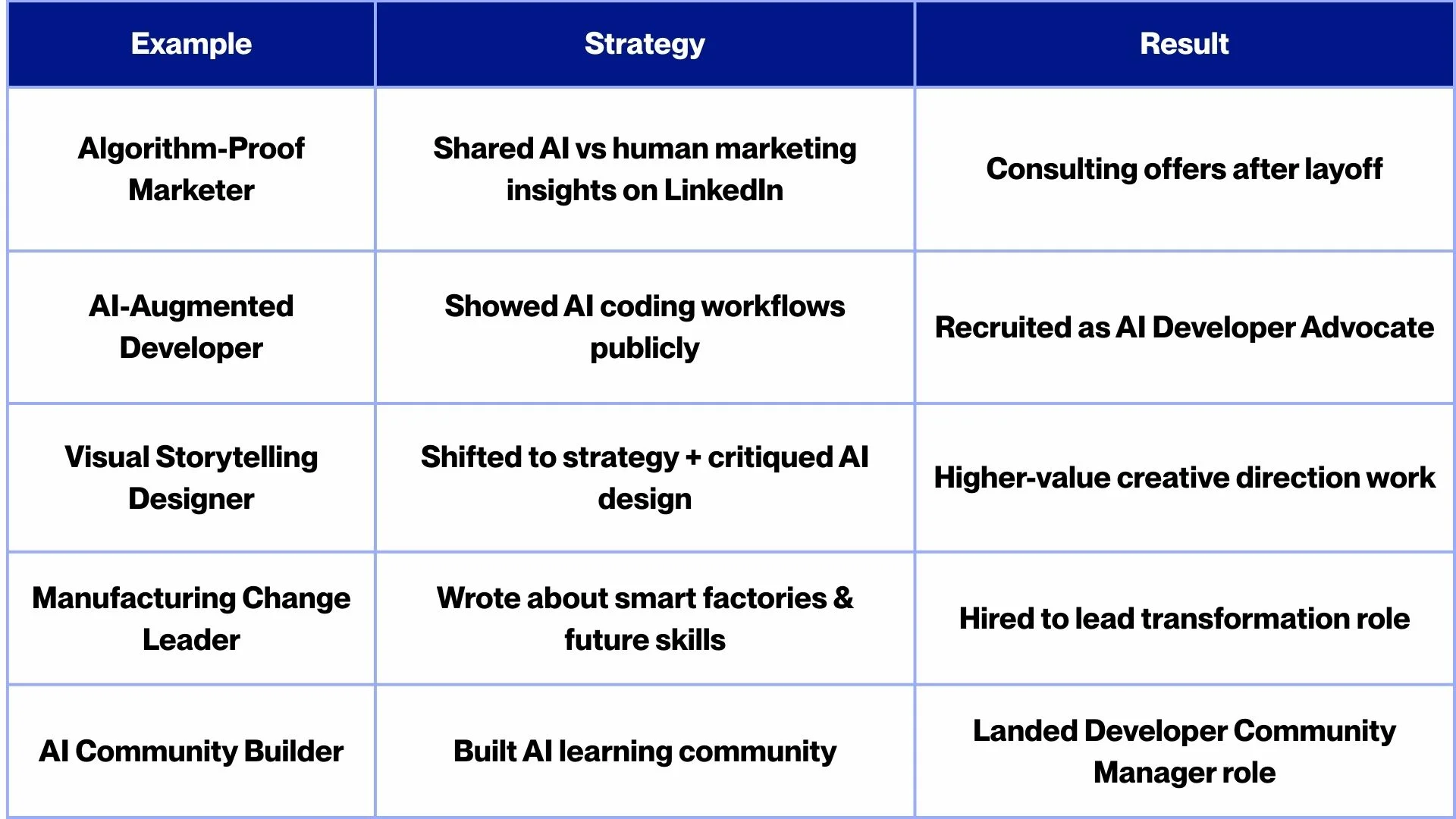
1. The "Algorithm-Proof" Marketer
Scenario: Mid-level marketing roles are increasingly consolidated as AI-driven programmatic tools take over routine campaign management.
- The Strategy: Jane, a retail marketing manager, didn't wait for a layoff to start sharing. For a year, she posted weekly LinkedIn experiments on "Human vs. AI Copywriting" and hosted a small podcast on brand storytelling.
- The Result: When her department downsized in early 2026, her "Open to Work" post didn't just get likes, it got inbound offers. Founders who had been following her "Marketing in the Age of AI" blog reached out for consulting.
- The Moat: Jane transformed from a "service provider" into a "strategic advisor." Her personal brand acted as a marketing funnel that she owned, independent of any employer.
2. The AI-Augmented Developer
Scenario: Backend engineering is being accelerated by AI coding assistants, raising the bar for "junior" coding tasks.
- The Strategy: Raj, a software engineer, branded himself as the "AI-Fluent Dev." He shared GitHub repositories showing how he used Copilot to build complex systems faster and live-tweeted reviews of new LLM coding benchmarks.
- The Result: Raj became a go-to name for startups looking to integrate AI into their engineering workflows. He didn't apply for his next job; he was recruited via Twitter for a newly created role: AI Developer Advocate.
- The Moat: By positioning himself as a leader of the change rather than a victim of it, his brand created a niche that paid significantly more than traditional coding roles.
3. The Visual Storyteller in the Generative Era
Scenario: Graphic design is being commoditized by tools like Midjourney and DALL-E 3, making "basic" design work low-value.
- The Strategy: Leticia, a designer, pivoted her brand from "Illustrator" to "Brand Strategist." She used YouTube to critique AI-generated art, explaining the human psychology and cultural context that the AI missed.
- The Result: While competitors lowered prices to match AI speed, Leticia raised hers. Clients hired her for the "human-led creative direction" that ensured their brand didn't look like an AI template.
- The Moat: She used her brand to educate her clients on the value of human intuition, making herself a "high-end" choice in a sea of cheap alternatives.
4. The Manufacturing Executive as a Change Agent
Scenario: Industry 4.0 and smart factories are making traditional operations management redundant.
- The Strategy: Michael, a manufacturing exec, began writing about "The Future of Smart Factories" and "Upskilling Teams for Robotics" long before his plant modernized. He spoke at industry conferences as a voice of the "Human-Centric Factory."
- The Result: When his firm underwent a massive restructuring, he wasn't just retained, he was poached by a global competitor to lead their Smart Factory Initiative.
- The Moat: His public-facing thought leadership convinced recruiters that he was a "transformation leader." His brand made him discoverable for the exact type of high-level role that companies prioritize during tech upheavals.
Takeaway: In each case, these professionals shared their journey while they were working. They didn't wait for a crisis to build their brand; they used their brand to ensure a crisis never became a career-ender.
5. Community Builders and Educators in AI
A powerful trend in 2026 is the shift from individual content creation to community building. Professionals who turn their personal brand into a hub for others are finding that their reputation as a "connector" is a significant career asset.
For example, a data analyst named Maria started a Slack community and a weekly Zoom meetup for women in AI. By building her brand as a leader in this space, she was not just seen as an analyst, but as a community authority. When AI began to disrupt traditional data roles, her reputation landed her a role at a top tech company as a Developer Community Manager, a high-demand pivot in 2026 as companies scramble to manage human-centric engagement in an automated world.
Proactive Branding as a Career Springboard
The common thread across these success stories is proactivity. These individuals shaped their narrative before the disruption hit. They were known for something specific, marketing insight, AI-fluent programming, or design strategy, beyond their job title.
- Providing Genuine Value: These brands weren't built on "faking it." They were built on sharing actual experiments, helping peers, and demonstrating skill in public.
- The "Small-Scale" Advantage: You don't need 10,000 followers to see results. Consistently helping others in a niche professional group or becoming the internal "go-to" for new tools at your current company is personal branding. It increases your "surface area for luck."
Conclusion: Your Brand is Your Best Investment
As we move deeper into the AI era, personal branding is the most effective way to turn potential obsolescence into upward mobility. It provides:
- Visibility: You are seen as a change agent, not a casualty.
- Optionality: Your network acts as a safety net, offering leads before they hit job boards.
- Authority: You move from being an interchangeable "doer" to a "trusted advisor."
By putting out intentional signals today, you ensure that when the winds of automation shift tomorrow, you have the momentum to leap ahead rather than struggle to keep up.
Final Thought: Embrace Personal Branding as Your AI-Age Career Catalyst
We are living through one of the most transformative epochs in the world of work. As of late 2026, AI is woven into every industry, changing how we hire, how we work, and how we build careers. In this landscape, personal branding has emerged as the linchpin of career growth and resilience. It directly influences how fast and far you can accelerate in an AI-driven economy because when algorithms sort through talent and automated systems churn out content, your reputation and unique human touch become the ultimate X-factors.
Key Takeaways for the AI Era
- Hiring Algorithms & AI Gatekeepers: In 2026, 85% of hiring managers prioritize candidates with strong personal brands. With AI screening resumes and LinkedIn profiles, your brand, including keywords, endorsements, and visible thought leadership, determines whether you get seen or skipped. Optimization is no longer optional; it is the signal that allows you to bypass digital gatekeepers.
- Trust Signals in a Commoditized World: As AI makes technical skills ubiquitous, your personal brand is the trust signal that you offer something extra: better judgment, reliability, or ethical alignment. Research shows that 46% of consumers now pay more for brands they trust, a trend that extends directly to the "brand of you."
- Human Differentiation & Credibility Moats: Leaning into creativity, empathy, and storytelling is a winning strategy. This builds a long-term "moat" around your career. While AI finds keywords, humans look for narrative. Your brand tells the story of how you use your skills and the impact you've made, details an algorithm cannot fake.
- Navigating AI Content Risks: Use AI as a tool, but keep your authenticity intact. A recent 2026 study highlights that "augmented authenticity", where humans remain the primary authors of their stories and use AI only for support, is the new currency. Mass-produced, generic AI content that lacks human insight is a fast track to losing credibility.
Real Examples Illustrate the Payoff
From marketers and developers to designers and executives, we’ve seen how personal branding makes the difference when automation comes knocking. The professionals who proactively cultivate their brands are not waiting to be disrupted; they are using their brand to ride the wave.
Branding is the long game. Build now, win forever.
Personal branding isn’t about ego; it’s about service and leadership. It’s about sharing knowledge, helping others, and building communities, which in turn shines a light on you as an expert. In an economy driven by AI, your personal brand is the most human thing you can bring. Not sure if your current brand is AI-proof? Ohh My Brand offers private audits to identify gaps and build a strategic credibility moat around your career. Contact Ohh My Brand for more details today.


.svg)
.svg)
.svg)
.svg)



.svg)